
20.03.2026
Common Contours #2. Mapping gender stereotypes: a comparison of views in Ukraine and the EU

How do gender stereotypes differ between Ukraine and EU countries? Find out in the second issue of the “Shared Contours” research series.
We remind you that “Shared Contours” is a survey exploring Ukraine in a European context, where we mirror questions and compare data from our own surveys of Ukrainians with data from other surveys conducted in EU countries, candidate countries, and other European countries. In this issue, we compare data from our own research with Eurobarometer data — a series of official EU surveys conducted by the European Commission and the European Parliament.
Note: Eurobarometer data belongs directly to the EU, and we are grateful for open access to it.
Key findings
We asked respondents to express their views on five statements about men and women drawn from the Eurobarometer survey.
"The most important role of a woman is to take care of the home and family"
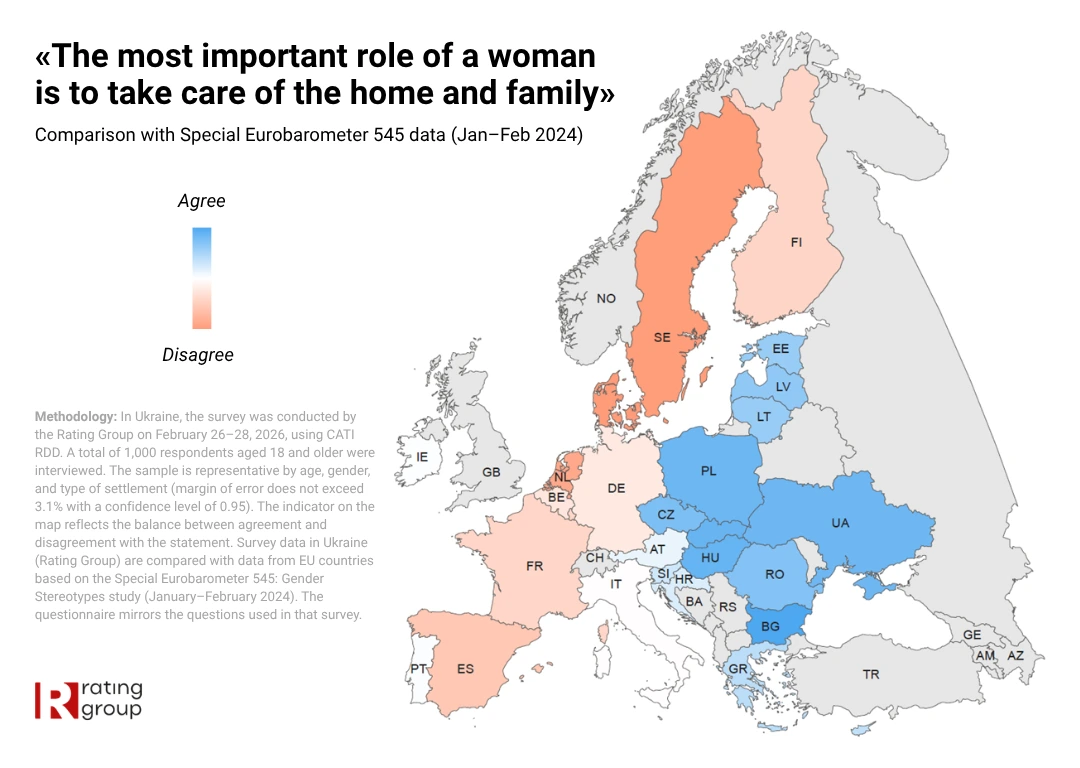
- 66% of Ukrainian respondents agree with this statement, while one-third disagree.
- In this context, the views of Ukrainians align with the general trend observed in Eastern Europe. However, Ukrainians support this statement less than respondents in countries such as Slovakia (75%), Bulgaria (74%), and Hungary (71%).
- At the same time, Ukrainians agree with this stereotype significantly more than EU citizens on average (42%).
"Overall, family life suffers when the mother works full-time"
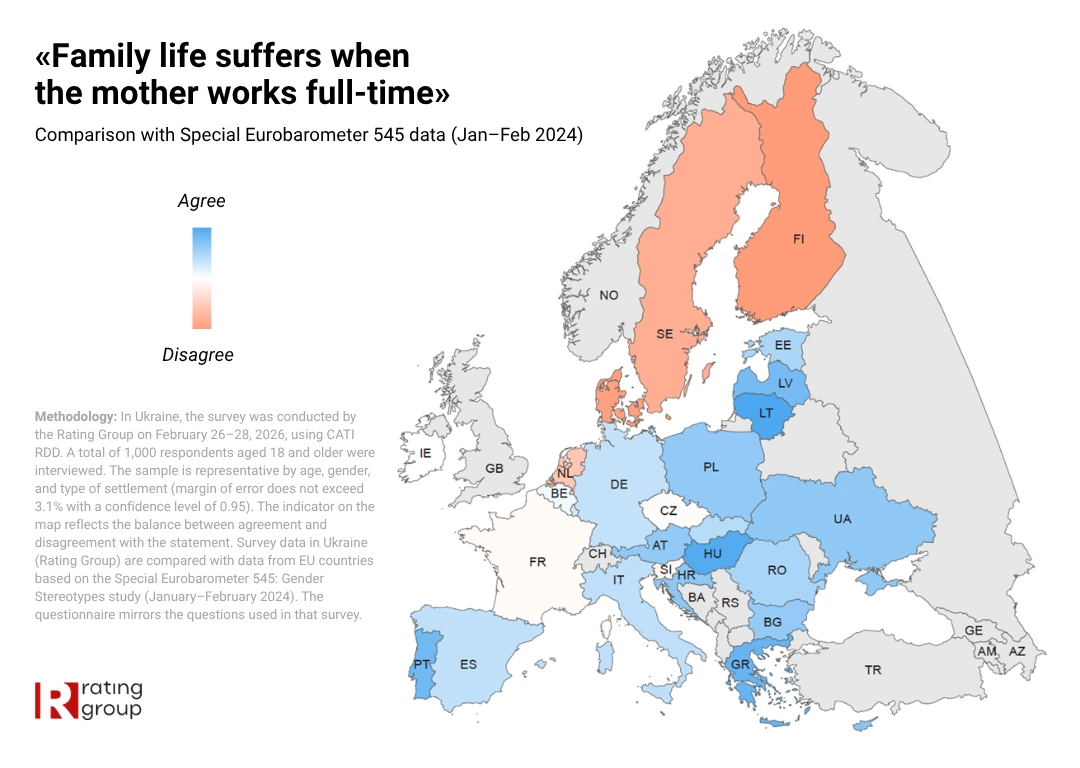
- The statement is supported by a majority of respondents in Ukraine (59%), while more than one-third (38%) disagree.
- Overall, this is a case where Northern European countries tend to stand out — there, the stereotype is supported significantly less. At the same time, on average in the EU, this idea is still more often supported (51%).
- Thus, overall, the views of Ukrainians in this context are comparable to the EU average.
"The most important role of a man is to earn money"
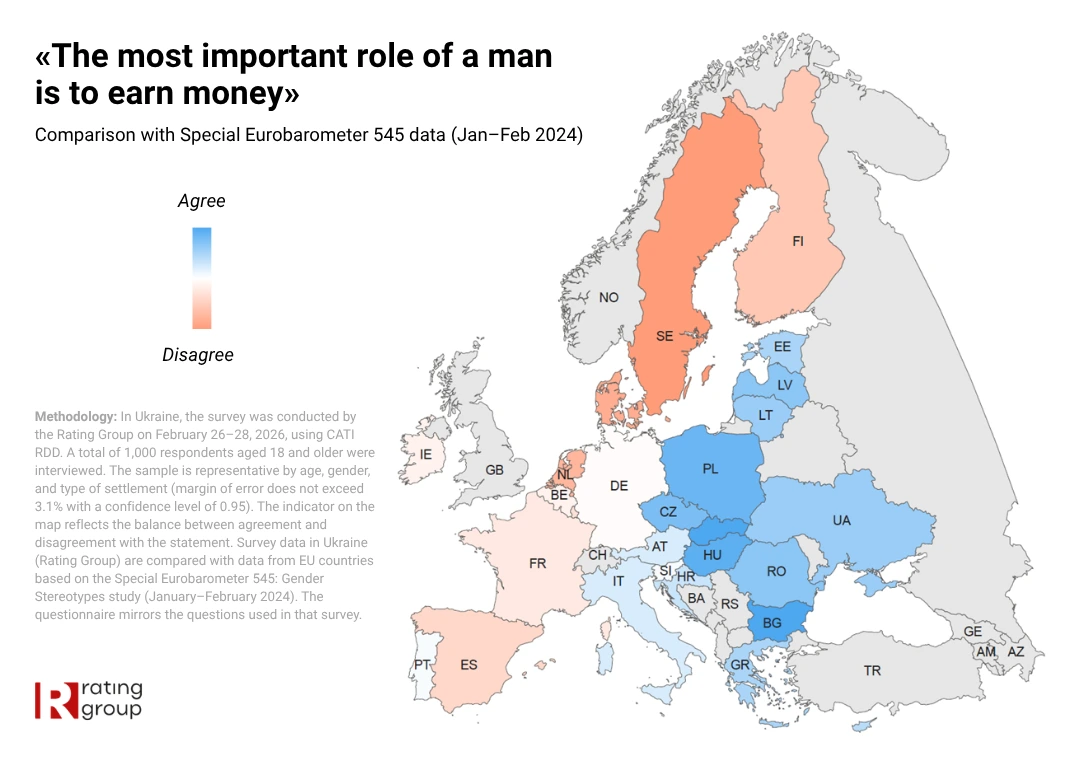
- Opinions on this statement in Ukraine are fairly divided: more than half agree (58%), while 40% do not support it.
- In this regard, Ukrainian society is close to countries such as Romania (60% agree) and the Baltic states (Latvia — 60%, Lithuania — 57%, Estonia — 55%).
- On average, across the 27 EU countries, 42% support this statement, meaning Ukraine appears more conservative in this respect.
"Women are not ambitious enough to hold top leadership positions in organizations"
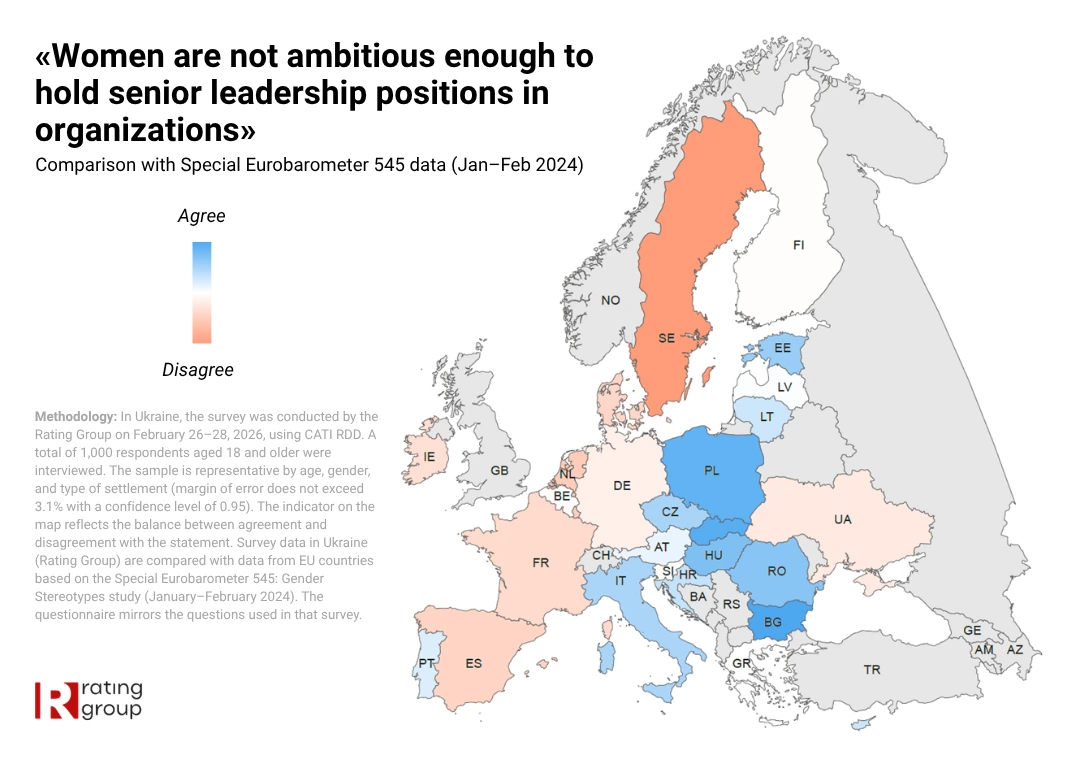
- An overwhelming majority of Ukrainians (81%) disagree with this career-related stereotype.
- In fact, in terms of disagreement with this statement, Ukraine exceeds the average level across EU countries and nearly all Eastern European countries. For comparison, 56% disagree in Poland and 61% in Hungary.
- This is essentially a case where Ukrainians reject stereotypes even more strongly than EU citizens on average (where 74% disagree with the statement).
"Overall, men are by nature less competent than women at performing household duties"
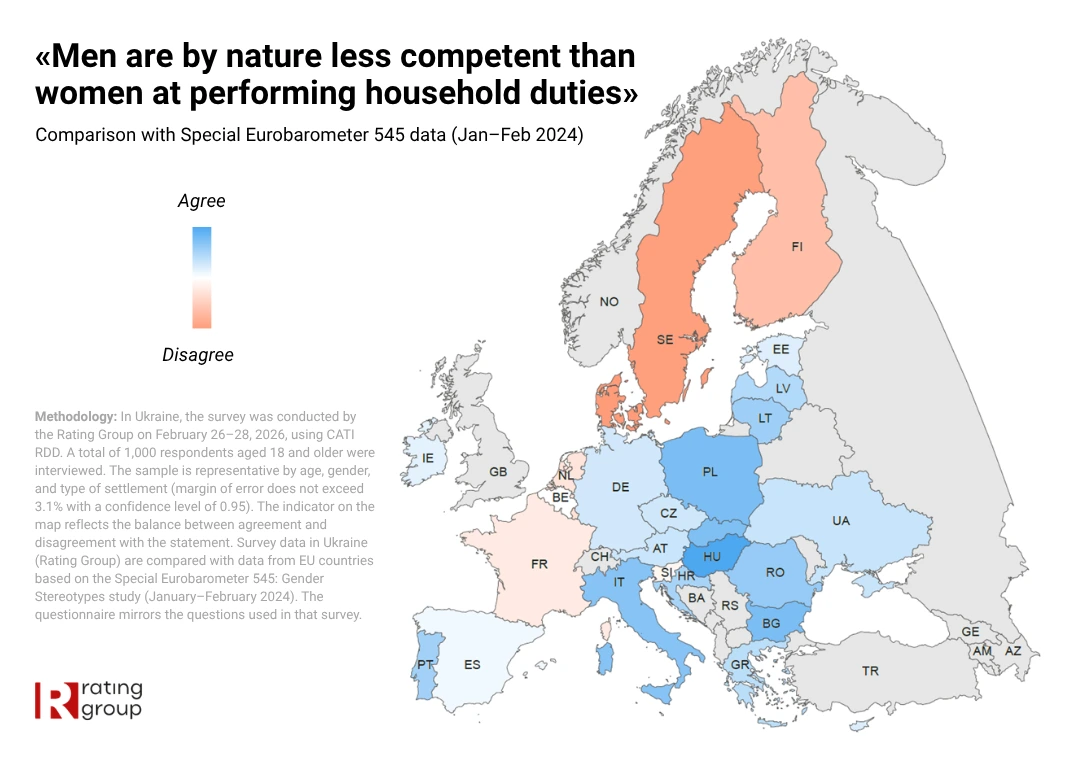
- Here, opinions among Ukrainians are almost evenly split: 49% support the statement, while 48% do not.
- Respondents in Ukraine are less likely to support this stereotype than their neighbors in Hungary (84% support), Poland (64%), and Slovakia (63%), as well as respondents in countries such as Italy (63%) and Bulgaria (61%).
- Overall, the distribution of opinions in Ukraine is very close to the EU average. The only notable difference is that, on average, fewer people in EU countries fully agree with the stereotype (15% compared to 20% in Ukraine).
Summary: The Eastern European trend and rejection of evaluating professional abilities based on gender
- Ukrainians generally do not support the idea that men or women are less capable of performing certain tasks (women in professional roles, men in household roles). This reflects a rejection of the notion that personal abilities depend on gender.
- At the same time, respondents in Ukraine tend to support a more traditional division of roles: men as breadwinners and women as caregivers responsible for the home and family.
- Less conservative views are more common among younger respondents aged 18–35, particularly among women.
- Overall, Ukrainian views on these gender issues are more conservative than those observed in Central, Northern, Western, and Southern Europe.
- Ukraine reflects broader trends typical of Eastern European countries, although in some cases Ukrainians are even less prone to gender stereotypes than neighboring societies. For example, the statement about women lacking ambition for leadership positions is rejected much more strongly in Ukraine than in Poland or Hungary.
Rating Group is one of the largest research institutions in Ukraine, operating since 2008. The company is registered in Ukraine and has extensive experience in conducting sociological surveys both domestically and internationally. The group includes: Sociological Group Rating, the research laboratory Rating Lab, the platform Rating Online, and the Rating Call Center.
Methodology
- Fieldwork period: February 26–28, 2026
- Method: CATI (Computer-Assisted Telephone Interviewing) — telephone interviews conducted using computer-assisted technology
- Sample size: 1,000 respondents
- Sampling design: Random sample of mobile phone numbers (population of Ukraine aged 18 and older in all regions, except for the temporarily occupied territories of Crimea and Donbas, as well as areas without Ukrainian mobile network coverage at the time of the survey). The results are weighted using the latest data from the State Statistics Service of Ukraine.
- Representativeness: The sample is representative by age, gender, and type of settlement (margin of error does not exceed 3.1% with a confidence level of 0.95).
Survey data in Ukraine (Rating Group) are compared with data from EU countries based on the Eurobarometer study (Special Eurobarometer 545. Gender Stereotypes, January–February 2024). The questionnaire mirrors the questions used in that survey.
Note: In some charts, totals may not sum to 100% due to rounding (including fractional values).
Contact form
Let's discuss your research idea
Fill in the form below, and we will contact you as soon as possible

