
News and Press releases
Search news and press releases

In the third issue of “Common Contours,” we compare how gender (in)equality is perceived in Ukraine and the EU.
We asked respondents to assess who is treated better in Ukraine across different areas of life: men, women, or everyone equally. The areas include
- healthcare institutions,
- educational institutions (schools, universities),
- mass media,
- the workplace,
- advertising,
- politics.
We remind you that “Common Contours” is a survey exploring Ukraine in a European context, where we mirror questions and compare data from our own surveys of Ukrainians with data from other surveys conducted in EU countries, candidate countries, and other European countries. In this issue, we compare data from our own research with Eurobarometer data — a series of official EU surveys conducted by the European Commission and the European Parliament.
Note: Eurobarometer data belongs directly to the EU, and we are grateful for open access to it.
Perceptions of gender (in)equality

- Equality is most visible in healthcare institutions, educational institutions, and the media (around 70% of respondents said that men and women are treated equally in these areas).
- A majority also believe that equality exists in the workplace (62%) and in advertising (57%).
- At the same time, respondents perceive the greatest inequality in politics: slightly more than one-third report equal treatment, while nearly half (47%) say that men are treated better in politics. In this context, there are also notable differences in responses between men and women.
When comparing perceptions of who is treated better in society:
- women are perceived to be treated relatively better in advertising (26% vs. 5% who say men are treated better), in schools and universities (17% vs. 8%), and in healthcare institutions (14% vs. 10%).
- men are more often seen as receiving better treatment in politics (47% say men are favored vs. only 6% for women) and, to some extent, in the workplace (17% vs. 14%).
Comparison between Ukraine and EU countries
- Ukrainians and respondents from the 27 EU countries share a high level of optimism regarding equality in healthcare and education: around 70% in both Ukraine and the EU on average say that men and women are treated equally in these areas. Similarly, in both Ukraine and the EU, more than half of respondents report equal treatment in advertising.
- At the same time, Ukrainians are significantly more optimistic about equality in the workplace and in the media. For example, in Ukraine, nearly two-thirds of respondents say that men and women are treated equally at work, whereas in EU countries this view is held by about 40% on average (and around half of respondents in the EU believe that men are treated better at work).
- As for politics, views in Ukraine and the EU are fairly similar. In both cases, more than one-third of respondents report equality, but more often respondents point to an advantage for men (47% in Ukraine and 54% in EU countries).
Breakdown by sectors
Healthcare institutions
- 70% of Ukrainians believe that men and women are treated equally in healthcare institutions, while 14% report a preference in favor of women.
- Men are noticeably more likely than women to say that women are treated better in healthcare. For example, one in five men aged 36–50 holds this view, compared to one in ten women in the same age group.
- Ukraine’s indicators are close to the EU average: the share of those who report equal treatment is nearly identical (around 70%). At the same time, Ukrainians are more likely than the EU average to report a preference for women (14% vs. 9% in the EU) and less likely to report better treatment of men (10% vs. 19%).
Schools and universities
- Nearly 70% of respondents in Ukraine say that men and women are treated equally in educational institutions. 17% report better treatment of women, while 8% say men are treated better.
- In this context, women are more likely than men to say that treatment is equal. Men are significantly more likely than women to report that women are treated better in education. For example, among men aged 18–35, 29% say that women are treated better in educational institutions, compared to 9% of women in the same age group. Similarly, 29% of men aged 36–50 share this view, compared to 14% of women in that age group.
- Ukraine’s indicators are similar to those of the EU: the share reporting equal treatment is nearly the same (around two-thirds). However, Ukrainians are more likely to report better treatment of women in education (17% vs. 9% in the EU) and less likely to report better treatment of men (8% vs. 20% in the EU).
Media
- In the context of media, 68% of respondents in Ukraine say that men and women are treated equally. Another 13% report more positive treatment of women, while 11% say men are treated better.
- There are no major differences between how men and women respond to this question overall. However, some differences appear in the older age group (51+): men are more likely to report better treatment of women (17% vs. 7% among women), while women are more likely to report better treatment of men (17% vs. 6% among men).
- Ukrainians assess equality in the media more optimistically than respondents in EU countries on average. While about two-thirds in Ukraine report equal treatment, this figure is 54% in the EU. In addition, 11% in Ukraine say men are treated better, compared to an EU average of 31% — nearly three times higher.
Workplace
- Two-thirds of Ukrainians believe that men and women are treated equally at work (62%). 17% say that men are treated better, while 14% believe that women receive better treatment in this sphere.
- The largest differences in responses are observed among younger respondents (aged 18–35). Young men and women tend to report preferences in favor of each other. For example, among young men, 23% believe that women are treated better at work (compared to 5% of women in the same age group). Among young women, in turn, 23% say that men are treated better (compared to 12% of young men).
- In Ukraine, significantly more respondents report equality at work than in EU countries (62% vs. 40%). Conversely, in EU countries, respondents are much more likely to say that men are favored in the workplace (51% vs. 17% in Ukraine) and less likely to report better treatment of women (6% vs. 14% in Ukraine).
Advertising
- Regarding advertising, 57% of respondents in Ukraine say that men and women are treated equally. A quarter of respondents (26%) report better treatment of women, while only 5% believe that men are treated better. Notably, 12% answered “don’t know.”
- The largest differences in responses are observed between men and women aged 36–50. Among men in this group, 45% say treatment is equal, while nearly the same share (44%) say women are treated better. In contrast, women aged 36–50 mostly report equal treatment (66%), with 16% noting better treatment of women.
- In the context of advertising, Ukrainians again report equal treatment more often than respondents in the EU on average (68% vs. 54%). Meanwhile, in the EU, respondents are three times more likely than in Ukraine to say that men are treated better in advertising (31% vs. 11% in Ukraine).
Politics
- Around one-third of Ukrainians (37%) believe that men and women are treated equally in politics. However, a relative majority (47%) say that men are treated better. Only 6% report better treatment of women, while another 10% are undecided.
- While men and women in other age groups show relatively similar response patterns, significant differences appear among younger respondents (aged 18–35). Among young women, only one-third believe that treatment is equal, while a majority (61%) say that men are favored. Young men see the situation differently: half (52%) report equal treatment, while 40% say men are favored.
- Assessments in Ukraine and the EU are broadly similar on this issue: in both cases, about one-third report equal treatment, while 47% in Ukraine and 54% in the EU on average say that men are treated better.
Rating Group is one of the largest research institutions in Ukraine, operating since 2008. The company is registered in Ukraine and has extensive experience in conducting sociological surveys both domestically and internationally. The group includes: Sociological Group Rating, the research laboratory Rating Lab, the platform Rating Online, and the Rating Call Center.

Наскільки українська молодь долучається до волонтерства та громадської активності загалом? Які напрями її цікавлять найбільше та які є бар'єри для участі?
Восени 2025 Rating Group (Соціологічна група "Рейтинг") розпитала про це понад 2 тисячі українців віком 14-35 років в Україні (а також 600 представників української молоді в країнах Європейського Союзу). Нижче - ключові знахідки в контексті громадянської участі молоді в Україні.
Ці знахідки є частиною великого комбінованого дослідження "Вплив війни на молодь в Україні 2025", що проводилося Rating Group за ініціативи Міністерства молоді та спорту України й підтримки Програми розвитку ООН (ПРООН, UNDP) в Україні та Уряду Данії. Дослідницький проєкт демонструє те, як почувається та як змінюється українська молодь під час повномасштабної війни.
Рівень залученості до волонтерства

- Більше як половина молоді в Україні має досвід волонтерської діяльності під час повномасштабного вторгнення (53%): 27% займалися волонтерством ще до повномасштабного вторгнення і продовжили після нього, тоді як 26% долучилися саме після 24 лютого 2022 року.
- Найчастіше молодь в Україні, яка займалася волонтерством, долучається з власної ініціативи (55%), через близьких, друзів і знайомих (42%) або через освітній заклад (11%).
- Ми також запитали молодих людей, які не займаються волонтерством, про бар'єри для участі. Найчастіше в переліку позначають брак вільного часу (56%), навичок і досвіду (24%), інформації (14%), інтересу чи мотивації (13%), а подекуди й недовіру до ініціатив (8%).
Рівень залученості до громадської активності
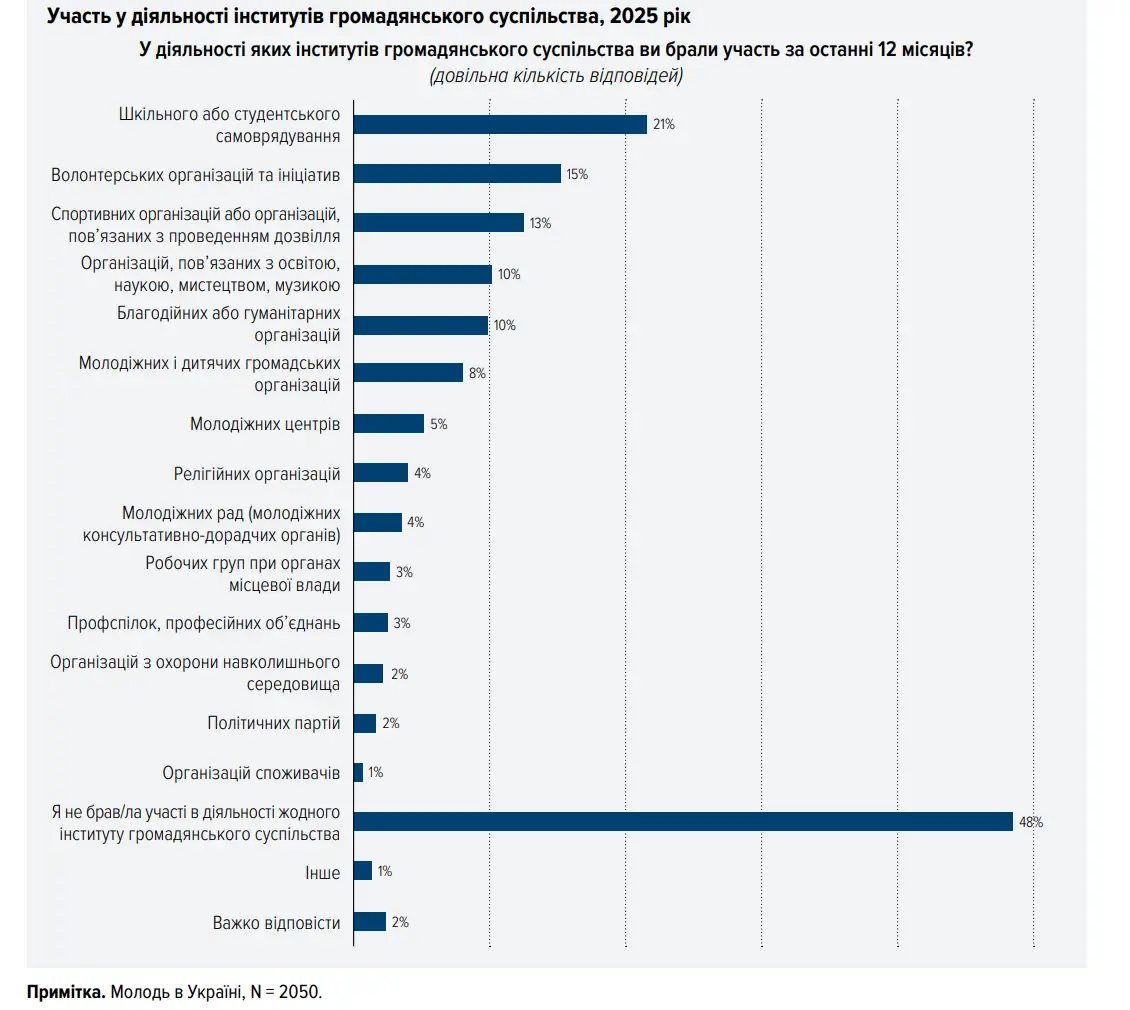
- Абсолютна більшість молоді в Україні (близько 80%) довіряє громадським і волонтерським асоціаціям. Водночас, показник особистої участі в інституціях громадянського суспільства ділиться приблизно навпіл: 48% молоді прямо зауважили, що за останні за останні 12 місяців на момент опитування не брали участі.
- 21% молоді брали участь у шкільному або студентському самоврядуванні, 13–15% – у спортивних або волонтерських організаціях, близько 10% – у діяльності освітніх, культурних, наукових чи благодійних організацій.
- 8% молодих людей зауважили, що найбільше хотіли б працювати саме в громадському секторі.
- Три чверті молодих респондентів (77%) готові долучатися до процесів відновлення в громаді. Утім більш як половина (54%) не відчуває можливість особисто впливати на зміни в громаді, відчувають - 44%.
- Найчастіше молоді люди, які не відчувають важелів впливу на життя громади, пояснюють це недостатніми знаннями й досвідом (33%), уявленням, що їхня думка нічого не змінить (30%), нерозумінням, як вони можуть впливати (30%), відсутністю видимих прикладів позитивних змін (16%), недовірою до процесів прийняття рішень (14%).
Молодіжні центри
- Відносна більшість молодих людей в Україні зазначає, що в їхній громаді є молодіжний центр (45%), натомість третина стверджує, що такого центру в громаді нема, а ще 19% відповіли "важко відповісти".
- Серед тих молодих людей, які зазначили про наявність молодіжного центру в громаді, 17% відвідують центри раз на місяць або частіше.
- Загалом практично половина молоді відвідує молодіжні центри хоча б інколи.
Напрями діяльності, що цікавлять молодь

- Найбільший інтерес серед молоді викликають формати участі, пов’язані з розвитком та отриманням нового досвіду: наприклад, стажування (27%) й молодіжні обмінах в межах України (25%).
- Крім того, 20% молоді цікавлять арт- та культурні проєкти, 18% – публічні заходи (фестивалі, форуми), 18 - освітні заходи (тренінги тощо), 16% - дискусійні клуби та дебати.
Rating Group — одна з найбільших дослідницьких інституцій України, яка на ринку з 2008 року. Компанія зареєстрована в Україні та має значний досвід проведення соціологічних опитувань в Україні та за кордоном. До групи входять: Соціологічна група Рейтинг, дослідницька лабораторія Rating Lab, платформа Rating Online та Rating Call Center.

How do gender stereotypes differ between Ukraine and EU countries? Find out in the second issue of the “Shared Contours” research series.
We remind you that “Shared Contours” is a survey exploring Ukraine in a European context, where we mirror questions and compare data from our own surveys of Ukrainians with data from other surveys conducted in EU countries, candidate countries, and other European countries. In this issue, we compare data from our own research with Eurobarometer data — a series of official EU surveys conducted by the European Commission and the European Parliament.
Note: Eurobarometer data belongs directly to the EU, and we are grateful for open access to it.
Key findings
We asked respondents to express their views on five statements about men and women drawn from the Eurobarometer survey.
"The most important role of a woman is to take care of the home and family"
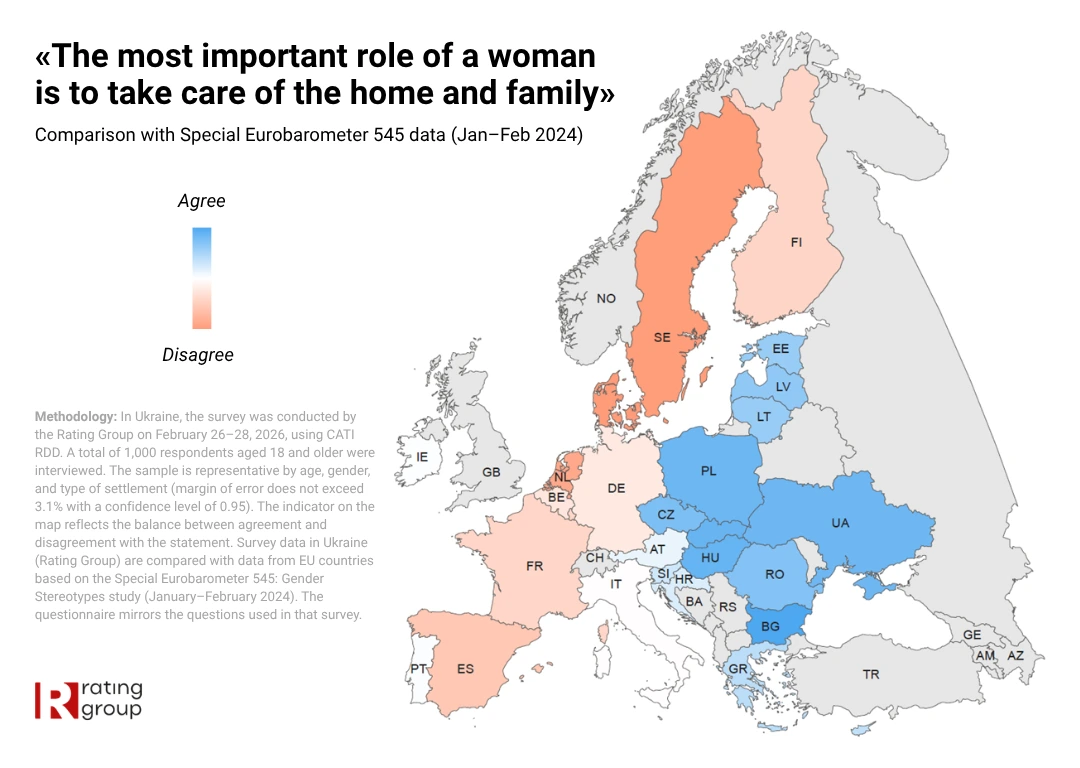
- 66% of Ukrainian respondents agree with this statement, while one-third disagree.
- In this context, the views of Ukrainians align with the general trend observed in Eastern Europe. However, Ukrainians support this statement less than respondents in countries such as Slovakia (75%), Bulgaria (74%), and Hungary (71%).
- At the same time, Ukrainians agree with this stereotype significantly more than EU citizens on average (42%).
"Overall, family life suffers when the mother works full-time"
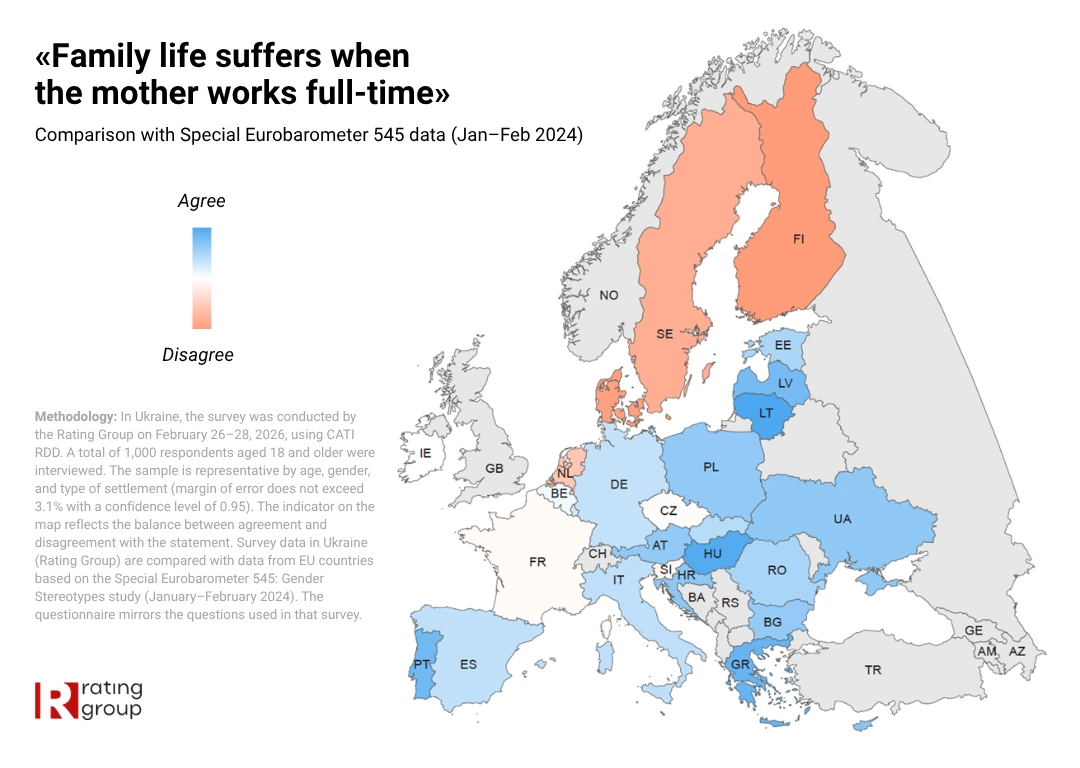
- The statement is supported by a majority of respondents in Ukraine (59%), while more than one-third (38%) disagree.
- Overall, this is a case where Northern European countries tend to stand out — there, the stereotype is supported significantly less. At the same time, on average in the EU, this idea is still more often supported (51%).
- Thus, overall, the views of Ukrainians in this context are comparable to the EU average.
"The most important role of a man is to earn money"
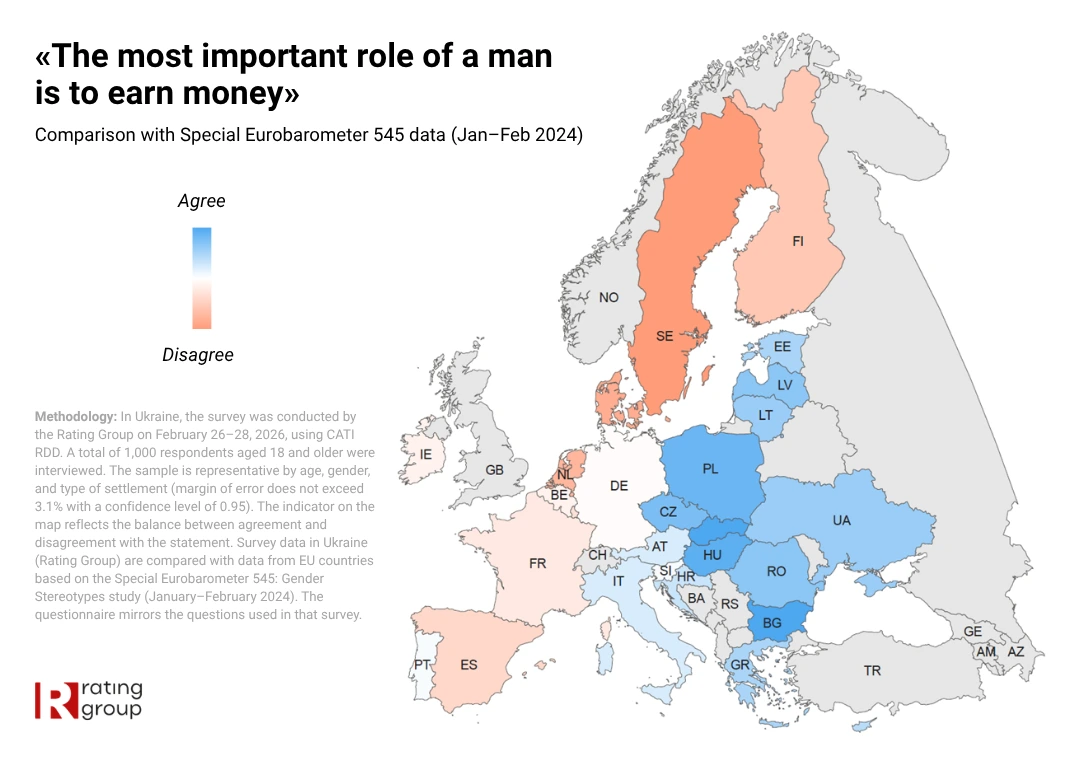
- Opinions on this statement in Ukraine are fairly divided: more than half agree (58%), while 40% do not support it.
- In this regard, Ukrainian society is close to countries such as Romania (60% agree) and the Baltic states (Latvia — 60%, Lithuania — 57%, Estonia — 55%).
- On average, across the 27 EU countries, 42% support this statement, meaning Ukraine appears more conservative in this respect.
"Women are not ambitious enough to hold top leadership positions in organizations"
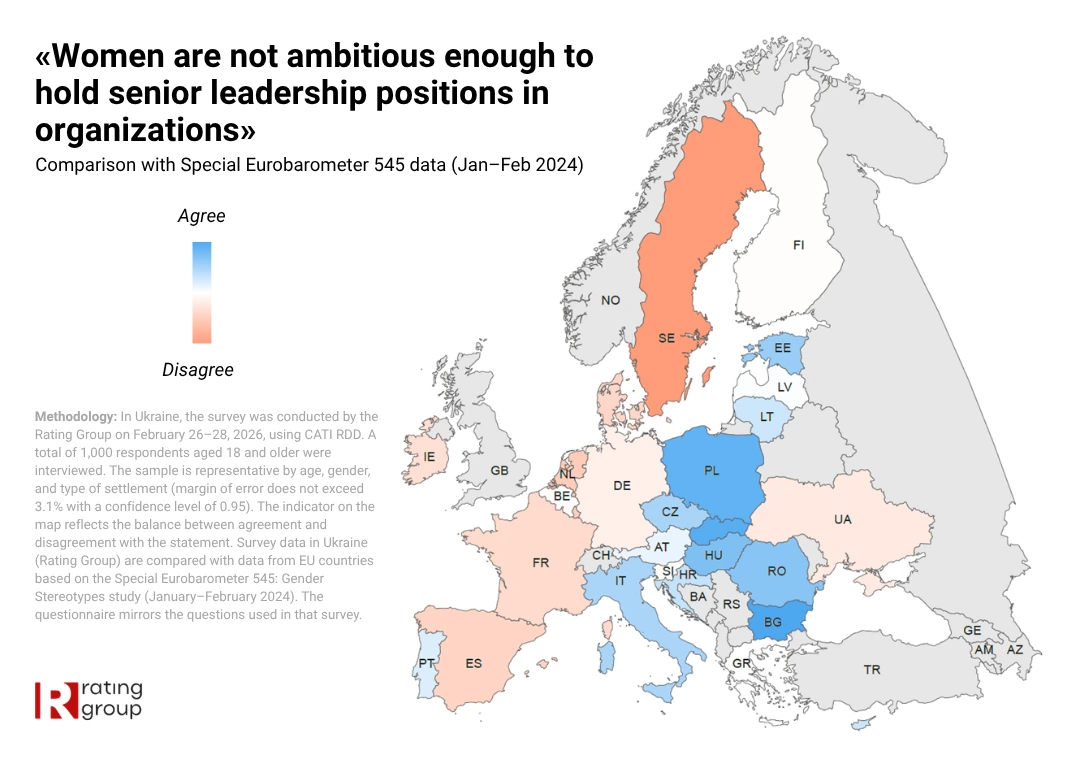
- An overwhelming majority of Ukrainians (81%) disagree with this career-related stereotype.
- In fact, in terms of disagreement with this statement, Ukraine exceeds the average level across EU countries and nearly all Eastern European countries. For comparison, 56% disagree in Poland and 61% in Hungary.
- This is essentially a case where Ukrainians reject stereotypes even more strongly than EU citizens on average (where 74% disagree with the statement).
"Overall, men are by nature less competent than women at performing household duties"
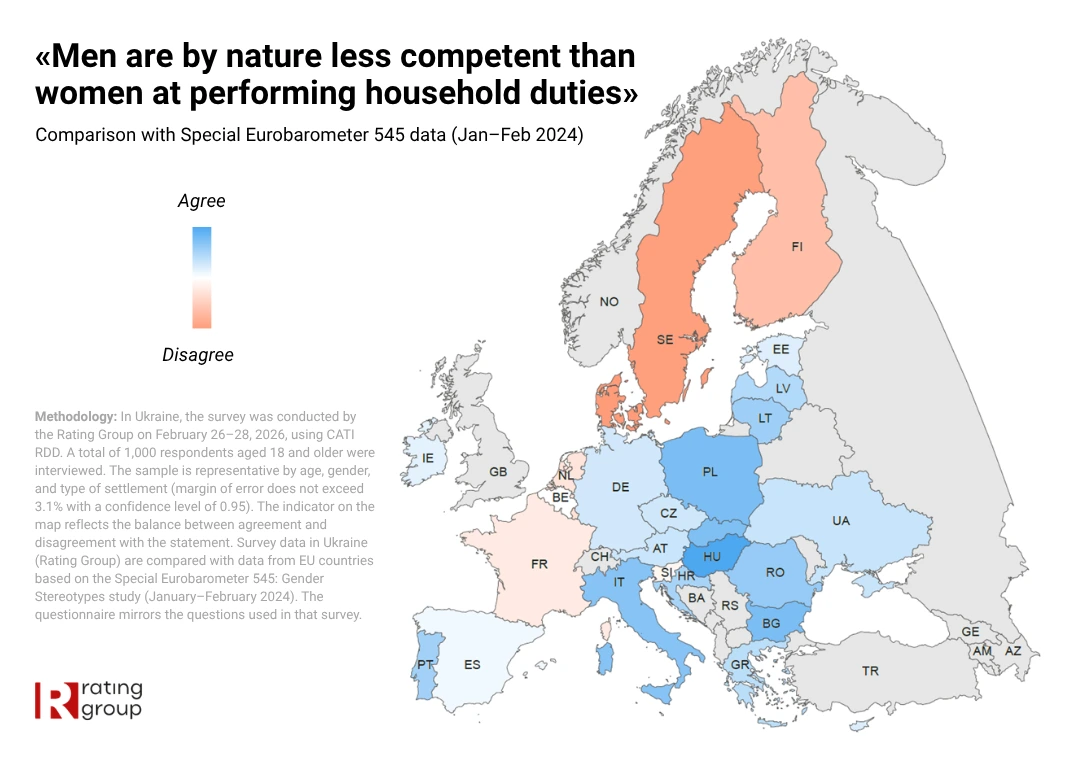
- Here, opinions among Ukrainians are almost evenly split: 49% support the statement, while 48% do not.
- Respondents in Ukraine are less likely to support this stereotype than their neighbors in Hungary (84% support), Poland (64%), and Slovakia (63%), as well as respondents in countries such as Italy (63%) and Bulgaria (61%).
- Overall, the distribution of opinions in Ukraine is very close to the EU average. The only notable difference is that, on average, fewer people in EU countries fully agree with the stereotype (15% compared to 20% in Ukraine).
Summary: The Eastern European trend and rejection of evaluating professional abilities based on gender
- Ukrainians generally do not support the idea that men or women are less capable of performing certain tasks (women in professional roles, men in household roles). This reflects a rejection of the notion that personal abilities depend on gender.
- At the same time, respondents in Ukraine tend to support a more traditional division of roles: men as breadwinners and women as caregivers responsible for the home and family.
- Less conservative views are more common among younger respondents aged 18–35, particularly among women.
- Overall, Ukrainian views on these gender issues are more conservative than those observed in Central, Northern, Western, and Southern Europe.
- Ukraine reflects broader trends typical of Eastern European countries, although in some cases Ukrainians are even less prone to gender stereotypes than neighboring societies. For example, the statement about women lacking ambition for leadership positions is rejected much more strongly in Ukraine than in Poland or Hungary.
Rating Group is one of the largest research institutions in Ukraine, operating since 2008. The company is registered in Ukraine and has extensive experience in conducting sociological surveys both domestically and internationally. The group includes: Sociological Group Rating, the research laboratory Rating Lab, the platform Rating Online, and the Rating Call Center.

What kind of self-realization do young Ukrainians seek? In which fields do they want to work, and how do they set their priorities?
In autumn 2025, Rating Group (Sociological Group “Rating”) surveyed more than 2,000 Ukrainians aged 14–35 in Ukraine, as well as 600 representatives of Ukrainian youth in European Union countries. Below we present the key findings of the quantitative phase in the context of professional self-realization.
These findings are part of a large-scale mixed-method study, “The Impact of War on Youth in Ukraine 2025,” conducted by Rating Group at the initiative of the Ministry of Youth and Sports of Ukraine, with the support of the United Nations Development Programme (UNDP) in Ukraine and the Government of Denmark. The research project highlights how Ukrainian youth feel and how they are changing during the full-scale war.
Priorities of young people over the next 5 years
Financial independence and self-realization are the key personal goals of young Ukrainians for the next five years.
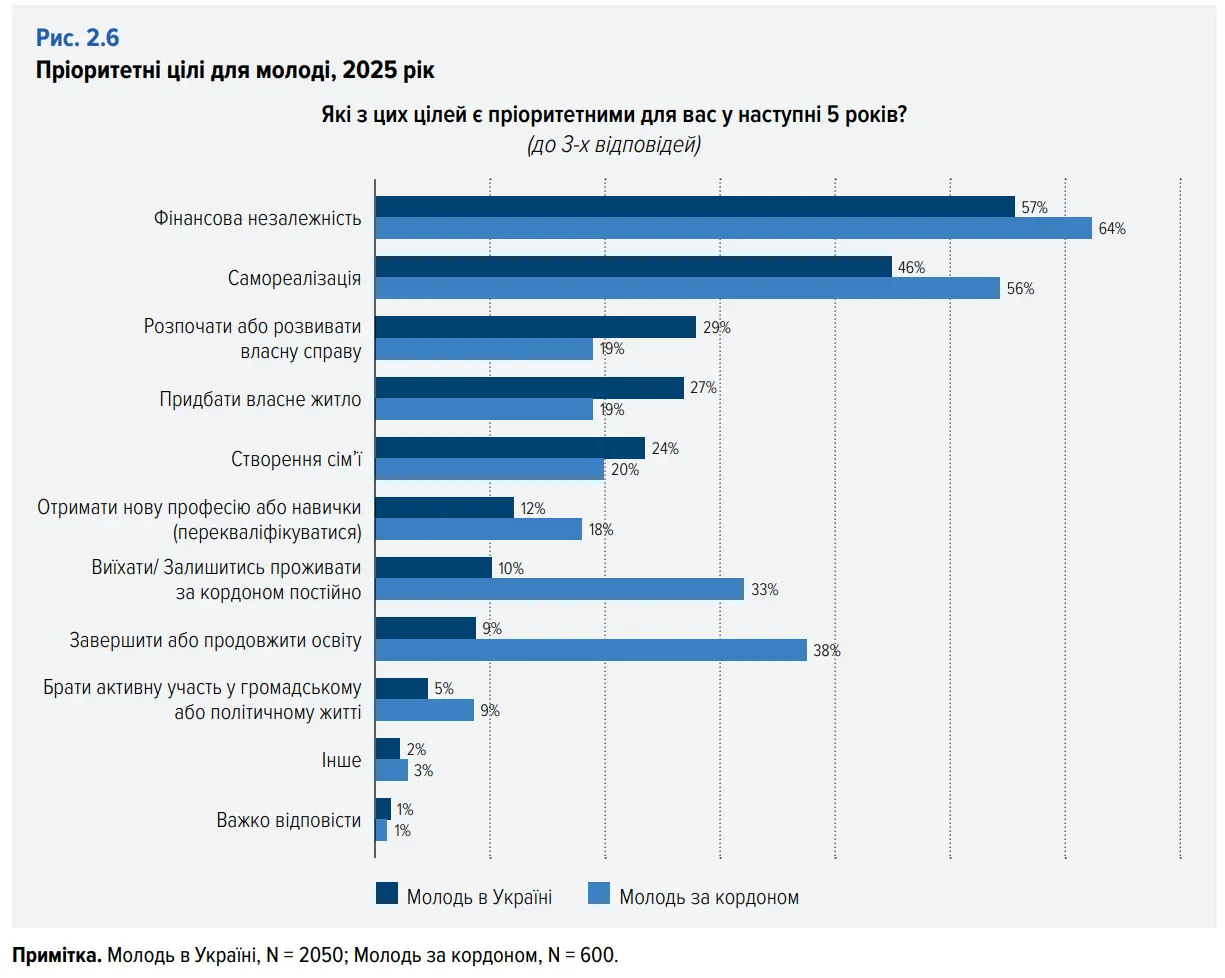
- The main personal priorities are financial independence (57% in Ukraine and 64% abroad) and self-realization (46% and 56%, respectively). In Ukraine, financial independence is more often emphasized by respondents aged 14–19.
- Young people in Ukraine are more likely to aspire to start their own business (29% compared to 19% among Ukrainian youth in the EU) and to purchase housing (27% compared to 19%).
- It is also expected that respondents aged 20–24 (37%) and 25–29 (30%) are more likely to plan starting a family within the next five years.
- Ukrainian youth abroad often mention the goal of settling abroad (33%), which aligns with plans to complete or continue their education (28%).
Where do they want to work?
Own business, IT, creative professions, and law are the most popular career paths among Ukrainian youth.
- Two-thirds of surveyed young people in Ukraine want to work in the private sector.
- Meanwhile, one in five respondents mentions the public sector, and 8% the civic sector.
- When asked to choose three most desirable professions, young people in Ukraine most often named entrepreneur (30%). Other popular choices include software specialist (17%), designer (18%), lawyer (15%), creative professions (14%), and manager in a commercial company (13%). Military service as a profession attracts 12% of respondents.
- Youth abroad are noticeably more likely to choose the following professions: entrepreneur (38%), software and computer technology specialist (28%), and creative professions (27%). At the same time, a quarter of respondents abroad (27%) selected the option “other profession” (compared to 7% in Ukraine).
Skills young people want to develop
Young people in Ukraine tend to focus more on digital literacy, while Ukrainian youth in the EU place greater emphasis on soft skills, resilience, and entrepreneurial abilities.
We asked respondents to select up to five skills they would like to develop in order to achieve their future plans.
- Among youth in Ukraine, the highest demand is for developing stress resilience and computer literacy (each selected by more than one-third of respondents). Around a quarter also highlighted the importance of creativity, entrepreneurial skills, and critical thinking.
- Youth abroad generally selected more options in this question. They place relatively greater emphasis on stress resilience (44% vs. 36% in Ukraine), entrepreneurial skills (37% vs. 23%), productivity (33% vs. 11%), as well as communication skills, adaptability, leadership, and social inclusion.
- Overall, youth abroad are more oriented toward soft skills related to adaptation and social interaction, while youth in Ukraine are relatively more focused on digital competencies (35% vs. 25% abroad).
Rating Group is one of the largest research institutions in Ukraine, operating since 2008. The company is registered in Ukraine and has extensive experience in conducting sociological research both domestically and internationally. The group includes the Sociological Group “Rating,” the research laboratory Rating Lab, the Rating Online platform, and the Rating Call Center.

17 березня 2026 у Києві презентували дослідження "Вплив війни на молодь в Україні 2025".
Цьогорічну хвилю опитування провела Соціологічна група "Рейтинг" (Rating Group) за ініціативи Міністерства молоді та спорту України й підтримки Програми розвитку ООН (ПРООН, UNDP) в Україні та Уряду Данії. Дослідницький проєкт демонструє те, як почувається та як змінюється українська молодь під час повномасштабної війни.
У рамках дослідження було опитано понад 2 тисячі респондентів віком 14–35 років в Україні та 600 у країнах ЄС. Як свідчать результати, які презентував співзасновник і CEO Rating Group Олексій Антипович, українська молодь зберігає оптимізм, незважаючи на обставини. Так, 78% молоді в Україні та 59% за кордоном відповіли, що вірять у своє майбутнє. Олексій Антипович коментує:
Коли мене запитують, "Що би ти досліджував далі?", я кажу, що досліджувати потрібно майбутнє. А молодь - це і є майбутнє нашої держави"
Під час презентації учасники обговорили зокрема:
- вплив війни не ментальне здоров'я молоді;
- уявлення молоді про свою роль у розвитку й відбудові України;
- пріоритетів молодих людей;
- оцінку соціально-економічних можливостей для молоді.

Учасники події також відзначили важливість таких досліджень для формування доказової державної молодіжної політики на основі ральних даних. Олена Урсу, керівниця групи проєктів з демократичного врядування ПРООН в Україні, зауважує:
"Молоді люди демонструють значну стійкість і готовність брати участь у відновленні України. [...] Водночас результати дослідження показують, що молодь потребує додаткової підтримки. Саме тому важливо, щоб рішення у сфері молодіжної політики ухвалювалися на основі даних, які дозволять молоді повноцінно реалізувати свій потенціал і відігравати активну роль у розвитку та відновленні України"
Схожу думку висловлює Уляна Токарєва, заступниця Міністра молоді та спорту України:
"Нам важливо говорити про реальність, яка вона є, говорити мовою фактів та мовою досліджень, які можуть вплинути на ті рішення, які ми приймаємо і на національному і на локальному рівнях. Міністерство молоді та спорту України завжди відкрито до співпраці та до побудови нових партнерств, для формування таких рішень, які вже сьогодні можуть відповідати на запити молоді"
.webp)
Rating Group is launching a special research project titled “Common Contours” — a survey exploring Ukraine in a European context.
The aim of the project is to help Ukrainian society, experts, and partners identify shared socio-cultural and political contours between Ukraine and the EU. This means supporting a more conscious process of European integration, understanding Ukraine’s strengths, while also recognizing existing challenges.
To achieve this, we mirror questions and compare data from our surveys of Ukrainians with data from other surveys conducted in EU countries and EU candidate countries.
"Ukraine is an important part of the broader European puzzle. It is essential to understand who we are within this puzzle, what our unique qualities are, and how we, together with EU and European countries, can strengthen one another. This is both about our identity and about what we share with other countries", – commented Hlib Kuzmenko, research expert and Head of Communications at Rating Group.
The first release of “Common Contours” has already been published on the Rating Group website. It focuses on how Ukrainians perceive the European Union and how these views differ from those of citizens in other European countries.

Rating Group is launching a special research project titled “Common Contours.” This is a survey exploring Ukraine in a European context, where we mirror questions and compare data from our own surveys of Ukrainians with data from other surveys conducted in EU countries, candidate countries, and other European countries.
In the first release of “Shared Contours,” discover how Ukrainians perceive the European Union compared to other European countries. This time, we compare data from our own research with Eurobarometer data — a series of official EU surveys conducted by the European Commission and the European Parliament.
Note: Eurobarometer data belongs directly to the EU, and we are grateful for open access to it.
Trust in the EU as an institution
A majority of Ukrainians trust the EU as an institution, with the level of trust being slightly higher than in some EU countries.
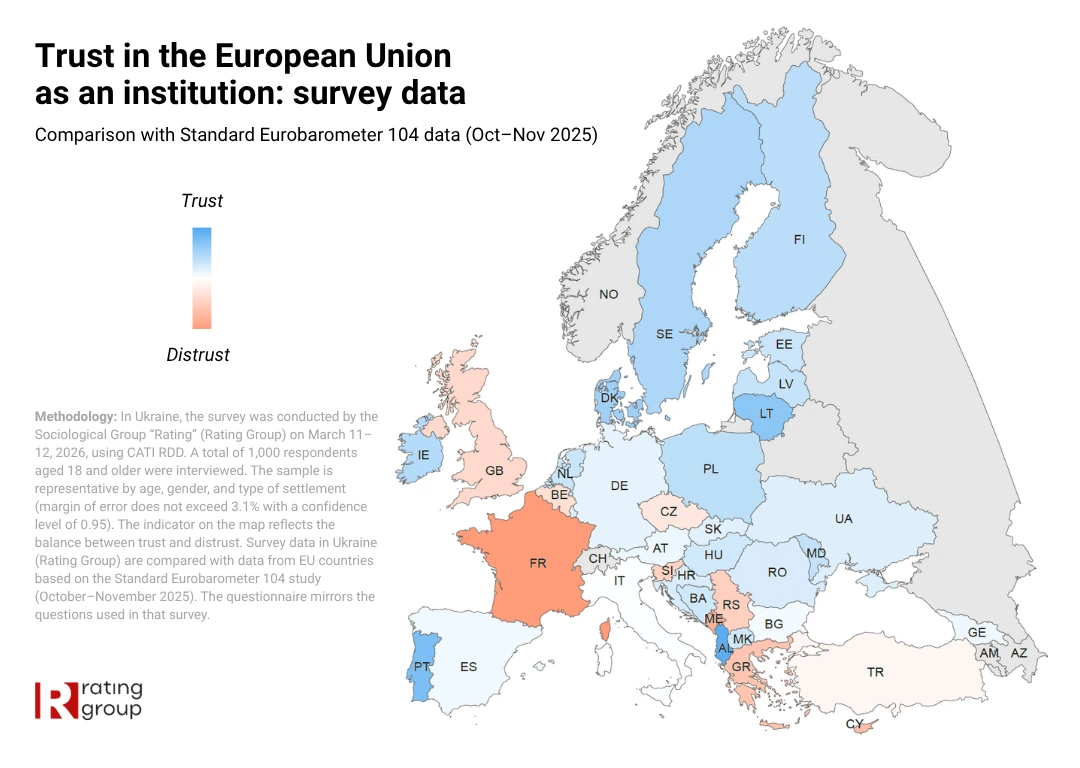
- A majority of Ukrainians trust the EU as an institution (53%), while 41% do not trust it, and another 6% remain undecided.
- In Ukraine, the level of trust in the EU is slightly higher than the average across EU countries themselves (48%).
- In particular, Ukrainians express higher levels of trust in the EU than citizens of several Western, Central, and Southern European countries, including France, Cyprus, Greece, Slovenia, Belgium, the Czech Republic, and Bulgaria.
- Among candidate countries, similar levels of trust in the EU are observed in Moldova (55%) and Bosnia and Herzegovina (56%).
Perceptions of the EU’s future
In the context of war, Ukrainians demonstrate cautious optimism about the future of the EU, along with slightly higher levels of skepticism compared to other candidate countries.
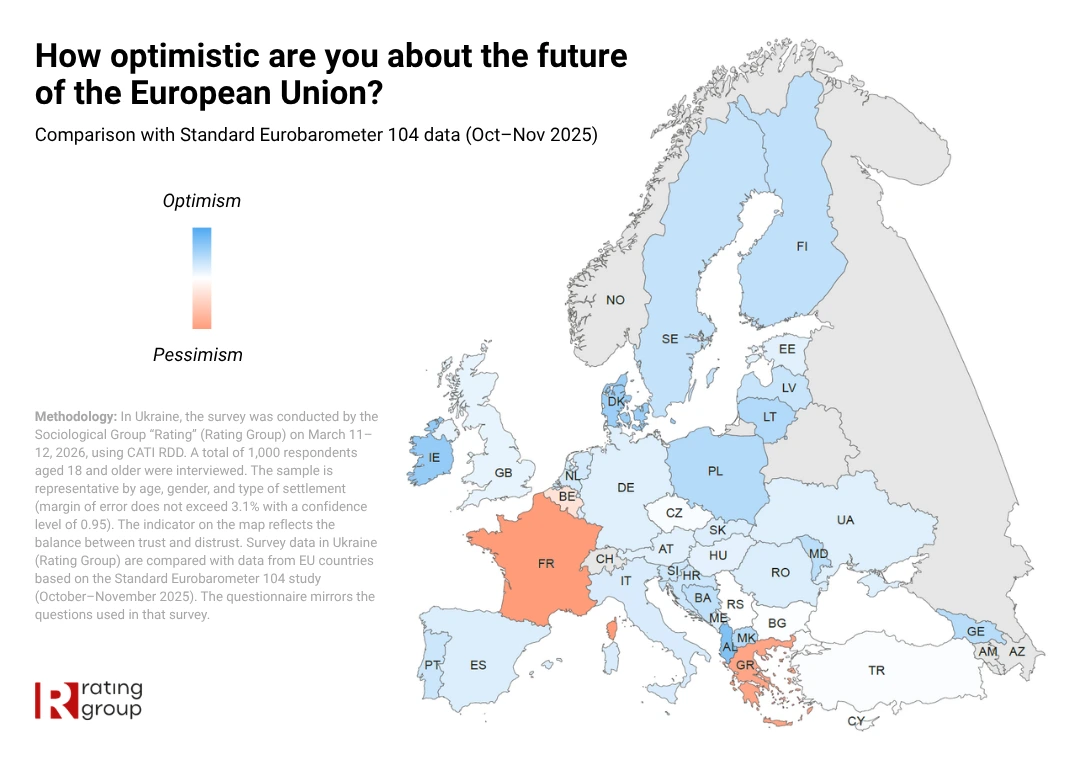
- More than half of respondents in Ukraine are optimistic about the future of the European Union (54%). At the same time, one-third of respondents (35%) hold a pessimistic view, while another 12% remain undecided.
- On average, across EU countries, 59% of respondents are optimistic, while 38% are pessimistic. In terms of the balance between positive and negative perceptions, Ukraine is fairly close to the overall European trend.
- However, Ukraine has a relatively high share of “don’t know” responses compared to most European countries (where this figure typically ranges between 1–5%).
- Among EU candidate countries, Ukraine demonstrates a relatively more restrained outlook. For example, in neighboring Moldova, 64% of respondents express optimistic views.
Emotional perception of the EU
Ukrainians follow the broader European trend of predominantly positive and neutral attitudes toward the EU.
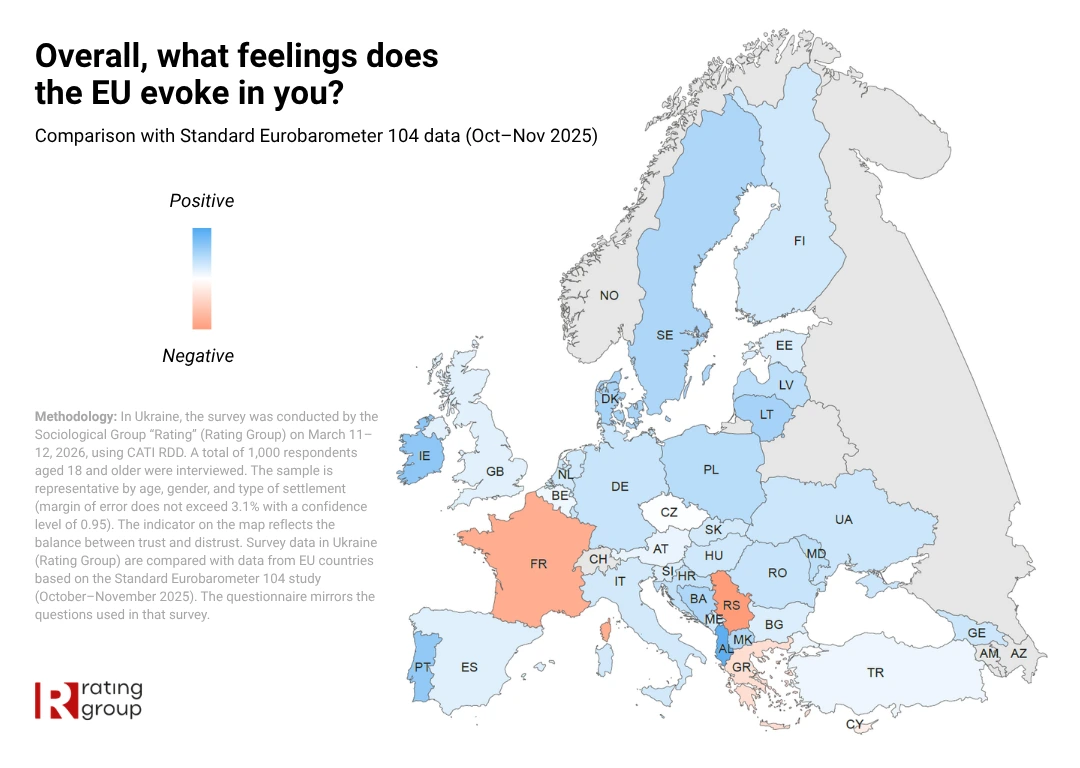
- A relative majority of Ukrainians have neutral feelings toward the EU (46%), while 40% express positive attitudes. Every tenth respondent reports a negative perception.
- In EU countries, on average, 38% report neutral feelings, 42% positive, and 19% negative. This means that in Ukraine there is a higher share of neutral perceptions, but also noticeably lower levels of negative sentiment toward the EU compared to many member states.
- Overall, in terms of the balance between positive and negative perceptions, Ukrainians align with the broader European trend.
- Compared to non-EU countries, perceptions of the EU in Ukraine are more positive than, for example, in Serbia (34%), Georgia (36%), or the United Kingdom (37% positive, but also 20% negative).
Rating Group is one of the largest research institutions in Ukraine, operating since 2008. The company is registered in Ukraine and has extensive experience in conducting sociological surveys both domestically and internationally. The group includes: Sociological Group Rating, the research laboratory Rating Lab, the platform Rating Online, and the Rating Call Center.

21 лютого – 3 березня 2026 Соціологічна група Рейтинг (Rating Group) провела опитування мешканців Закарпатської області щодо бачення загальної ситуації в області та окремих питань економічного розвитку.
Оцінка загальної ситуації
- Думки щодо стану справ в Закарпатській області розділилися: 45% кажуть, що справи рухаються в правильному напрямку, 42% – що в неправильному, а ще 13% – вагаються.
- Так само різняться думки щодо економічного зростання регіону: половина респондентів не помічає покращення, натомість 45% вважають, що покращення є, а 5% – вагаються.
- Більш оптимістично щодо загальної ситуації економічного зростання регіону налаштована молодь віком 18-35, більш забезпечені категорії населення, частіше мешканці Ужгорода.
Ставлення до ініціатив з релокації до Закарпаття
- Абсолютна більшість респондентів позитивно ставиться до ініціатив з релокування інфраструктури з інших регіонів до Закарпаття для її забезпечення.
- Так, переміщення закладів вищої освіти до Закарпатської області підтримують 74% опитаних. Ще 18% ставляться нейтрально, а негативно – 6%.
- До переміщення підприємств до області добре ставляться 68%, ще 18% – нейтрально. а негативно – 9%.
Ставлення до деяких економічних ініціатив
- Будівництво вітрових електростанцій у горах для генерації електроенергії в регіоні також підтримує більшість респондентів (68%), проти – 24%. Ініціатива є більш популярною серед мешканців сіл та інших міст, менше підтримується – в Ужгороді.
- Більшість також підтримує будівництво гідроелектростанцій на річках (63%), натомість проти цього виступає кожен четвертий респондент (29%).
Rating Group — одна з найбільших дослідницьких інституцій України, яка на ринку з 2008 року. Компанія зареєстрована в Україні та має значний досвід проведення соціологічних опитувань в Україні та за кордоном. До групи входять: Соціологічна група Рейтинг, дослідницька лабораторія Rating Lab, платформа Rating Online та Rating Call Center.

Do Ukrainians notice inequality between men and women? Which gender stereotypes are still widespread, and which have already faded? Are Ukrainians today supporters of a traditional division of gender roles within the family or a couple?
Ultimately, how has Ukrainian society changed in this regard over the past decade?
To explore these questions, at the end of February 2026 Rating Group and the research laboratory Rating Lab surveyed Ukrainians on issues of gender (in)equality, stereotypes, and perceptions of relationships within families and couples. The results are presented in a dynamic perspective, comparing the findings with similar studies conducted in 2015 and 2021.
"Our longitudinal research indicates a gradual transformation of gender perceptions in Ukraine: gender equality is perceived more strongly, traditional stereotypes are weakening, and partnership-based models are becoming more acceptable, especially among young people, who tend to be more progressive and egalitarian,” summarizes Marianna Tkalych, CEO of Rating Lab, Professor, Doctor of Psychological Sciences.
Perception of inequality
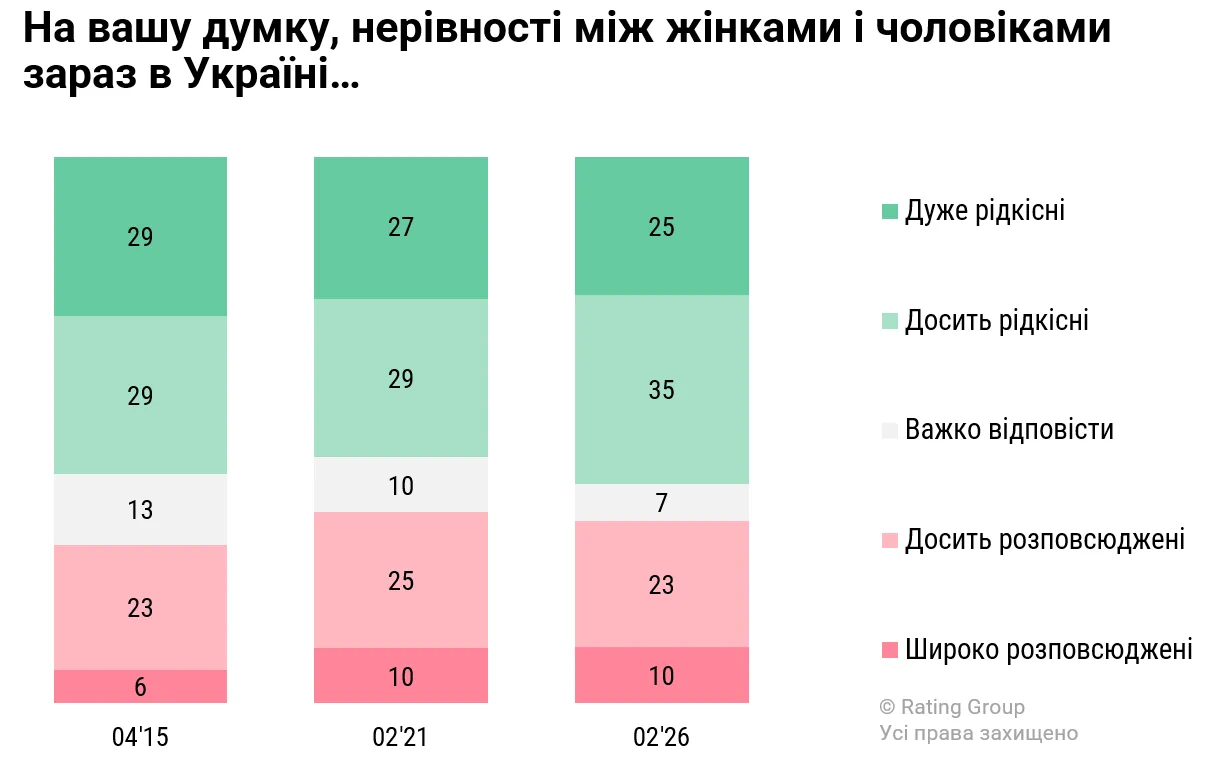
Most Ukrainians consider gender inequality to be a relatively rare phenomenon in the country, and this perception has not changed significantly over the past decade.
- 60% of respondents say inequality between men and women is generally rare in Ukraine. About one third hold the opposite view, while 7% find it difficult to answer.
- Over the last ten years, there have been no major shifts in overall perceptions of this issue.
- However, pessimism has increased among young men aged 18–35: in 2021, 30% of them believed inequality was widespread, whereas today 41% do.
- At the same time, young women aged 18–35 have become somewhat more optimistic: in 2021, 42% in this group believed inequality was widespread, whereas today this share has declined to about one third.
Gender stereotypes
Prejudice regarding men and women is gradually declining in Ukrainian society, with young people increasingly rejecting traditional stereotypes.
Respondents were asked whether they agree or disagree with several gender stereotypes that were previously widespread.
The majority reject almost all of them. The only exception is the belief that a man should fully provide for his family, supported by 69% of respondents.
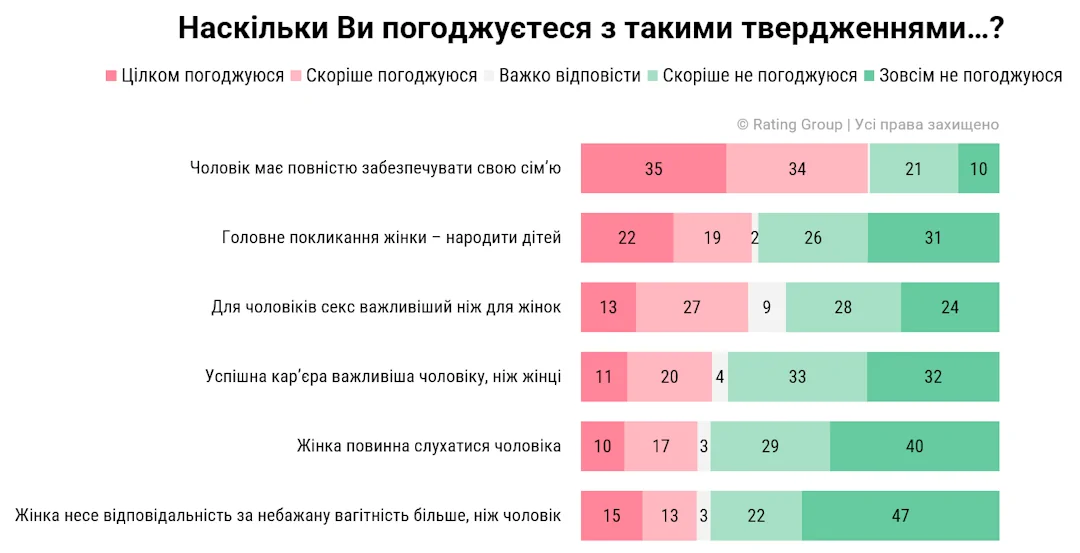
At the same time, all of these stereotypes have become less widespread over the past five years. The most notable declines are in the ideas that a successful career is more important for men and that a woman should obey her husband.
“A man should fully provide for his family”
- This is the only stereotype supported by a majority across all gender and age groups.
- Relatively fewer young women (60%) agree with this statement compared to older women (66%) and men overall (72–74%).
- Support for this idea has gradually decreased over time: the average index on a scale from 1 (“strongly disagree”) to 4 (“strongly agree”) declined from 3.3 in 2015 to 2.9 in 2026.
“A woman’s main calling is to have children", “A successful career is more important for a man than for a woman”
- Most Ukrainians reject these stereotypes. 57% oppose the first statement, while 65% oppose the second.
- Young people stand out particularly strongly in this regard. For example, 75% of young men and 85% of young women aged 18–35 reject the idea that motherhood is a woman’s primary calling.
- By contrast, among respondents aged 51+, the majority still support this idea (54% of women and 59% of men).
“Sex is more important for men than for women”
- Opinions are more evenly divided on this issue. A slight majority (52%) do not support the statement, while 40% agree with it, and 9% are undecided.
- Again, younger respondents are more likely to reject this stereotype: two thirds of men aged 18–35 and 60% of women in the same age group disagree with it.
“A woman should obey her husband", “Women bear more responsibility for unwanted pregnancy than men”
- These stereotypes are rejected by 69% of respondents.
- The shift over time is also significant. The index for the statement “a woman should obey her husband” decreased from 2.8 in 2015 to 2.0 in 2026.
- Similarly, the index for the statement “women bear more responsibility for unwanted pregnancy than men” fell from 2.4 in 2015 to 2.0 today.
Roles in the family and in relationships
В In Ukrainian families and couples, elements of the traditional division of roles still remain. Women are more often responsible for cooking (60%) and household chores (48%), while men are more often seen as earning the main income (68%).
These questions were asked of respondents who currently have or previously had a partner.
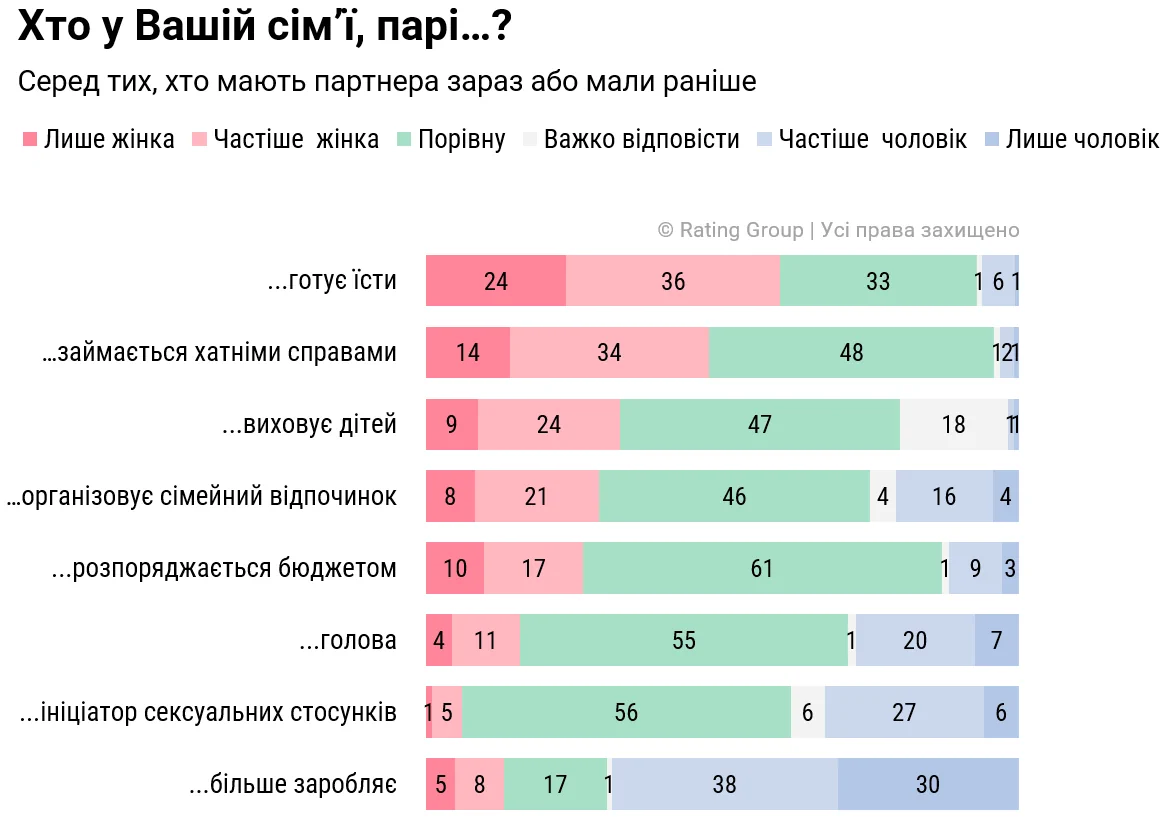
- The responsibilities most often shared equally are managing the family budget (61%), initiating sexual relations (56%), leading the family (55%), child-rearing responsibilities (48%), and organizing leisure activities (46%).
- At the same time, when comparing who is perceived as more responsible — the man or the woman — respondents tend to attribute cooking, household chores, child-rearing, organizing family leisure, and managing the family budget relatively more to women. Men, in turn, are more often associated not only with earning income, but also with family leadership and initiating sexual relations.
- In the dynamic perspective, we observe that cooking, child-rearing, and family leadership are roles gradually shifting toward a partnership-based format, meaning they are increasingly shared equally. However, the role of earning income continues to be delegated primarily to men.
- Young people are significantly less inclined to support traditional models and instead prefer a more egalitarian (equal) distribution of roles. The main exception again concerns income: 80% of men aged 18–35 believe this responsibility should lie with men, and 74% of women in the same age group share this view.
Rating Group is one of the largest research institutions in Ukraine and has been operating on the market since 2008. The company is registered in Ukraine and has extensive experience conducting sociological surveys both in Ukraine and abroad. The group includes Sociological Group Rating, the Rating Lab research laboratory, the Rating Online platform, and the Rating Call Center.
Today our social research laboratory Rating Lab celebrates its 5th anniversary! 🎂
When you are a scientist, sometimes you want to step outside the academic bubble. And when you work in applied sociology, sometimes you want to understand the world more deeply.
That is why in 2021, Rating Group founder Ihor Tyshchenko and Professor, Doctor of Psychological Sciences Marianna Tkalych established a research laboratory designed to combine “the best of both worlds” and strengthen Ukrainian science:
💙 the speed and resources of applied sociological research provided by Rating Group
💙 the academic depth and expertise of the social sciences
Over these five years, Rating Lab has become a driver of a series of bold social research projects and methodological developments:
- the Family 360° family research technology, which compares the responses of children and their parents
- a comprehensive study of well-being and mental health among adolescents and their parents, conducted with leading child and family psychologist Svitlana Roiz
- a unique mine safety study among adolescents and their parents for UNICEF Ukraine, the results of which were used in educational campaigns by the State Emergency Service of Ukraine and by the developers of S.T.A.L.K.E.R. 2
- “Mind Frames”, a study of mental health and resilience among adolescents, parents, and youth conducted together with UNICEF and the “How Are You?” (Ty Yak?) initiative
- the Regional Well-being Index rankings for 2023 and 2024
- a study of perceptions of gender stereotypes and family models, which will be released very soon
And there are also several unique developments related to audience segmentation within Ukrainian society, which we are not yet ready to discuss publicly. Often, the most interesting work remains behind the scenes.
Today we are proud of this team and of the synergy between Academia × Business. Congratulations to our colleagues, and thank you to everyone who has been part of this journey!

Більшість українців виступає проти блокування Telegram в Україні, але підтримує активніший контроль з боку правоохоронних органів
Про це свідчать результати нового всеукраїнського опитування Соціологічної групи Рейтинг (Rating Group).
Нещодавно в публічному просторі поновилася дискусія щодо блокування (обмеження) роботи месенджера Telegram. Тож наприкінці лютого 2026 Rating Group запитала в українців, що вони думають з цього приводу.
Користування Telegram
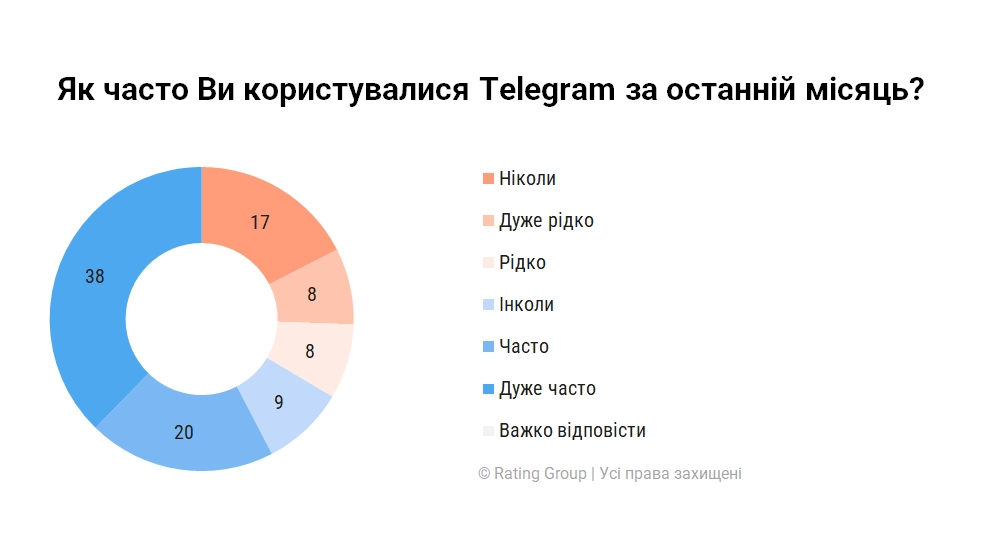
- Загалом 67% українців є більш-менш активними користувачами Telegram.
- Частіше ним користуються молодші респонденти, мешканці Києва й обласних центрів, громадяни з вищим рівнем доходів.
Оцінка безпечності месенджера
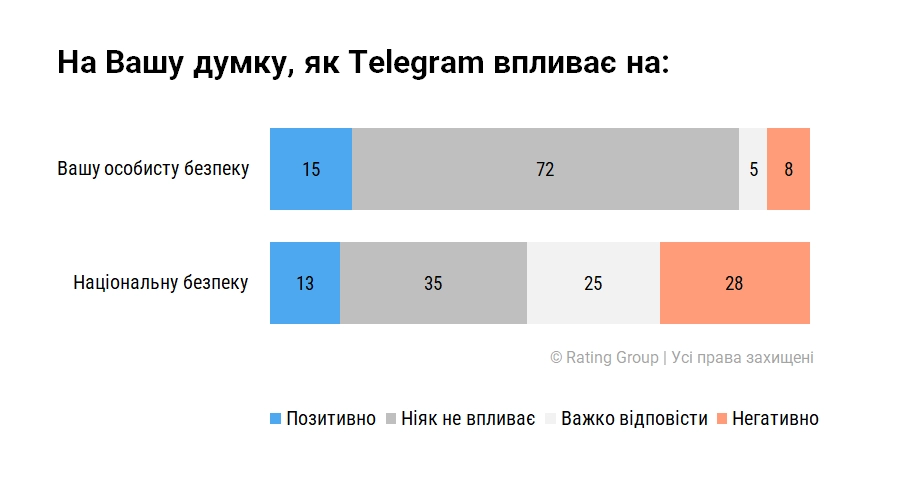
Більшість не бачить загрози для себе особисто, але відносно частіше визнають про ризики для національної безпеки
- Абсолютна більшість респондентів (72%) вважає, що Telegram ніяк не впливає на їхню особисту безпеку. Лише 8% вважають, що користування месенджером негативно впливає на особисту безпеку, а 15% - що позитивно.
- Щодо впливу на національну безпеку думки респондентів розходяться. Близько третини висловлюють думку, що ніякого впливу нема, а ще чверть вагається з відповіддю.
- Водночас, кожен 4-й респондент (28%) вважає, що Telegram негативно впливає на національну безпеку.
Ставлення до обмеження Telegram
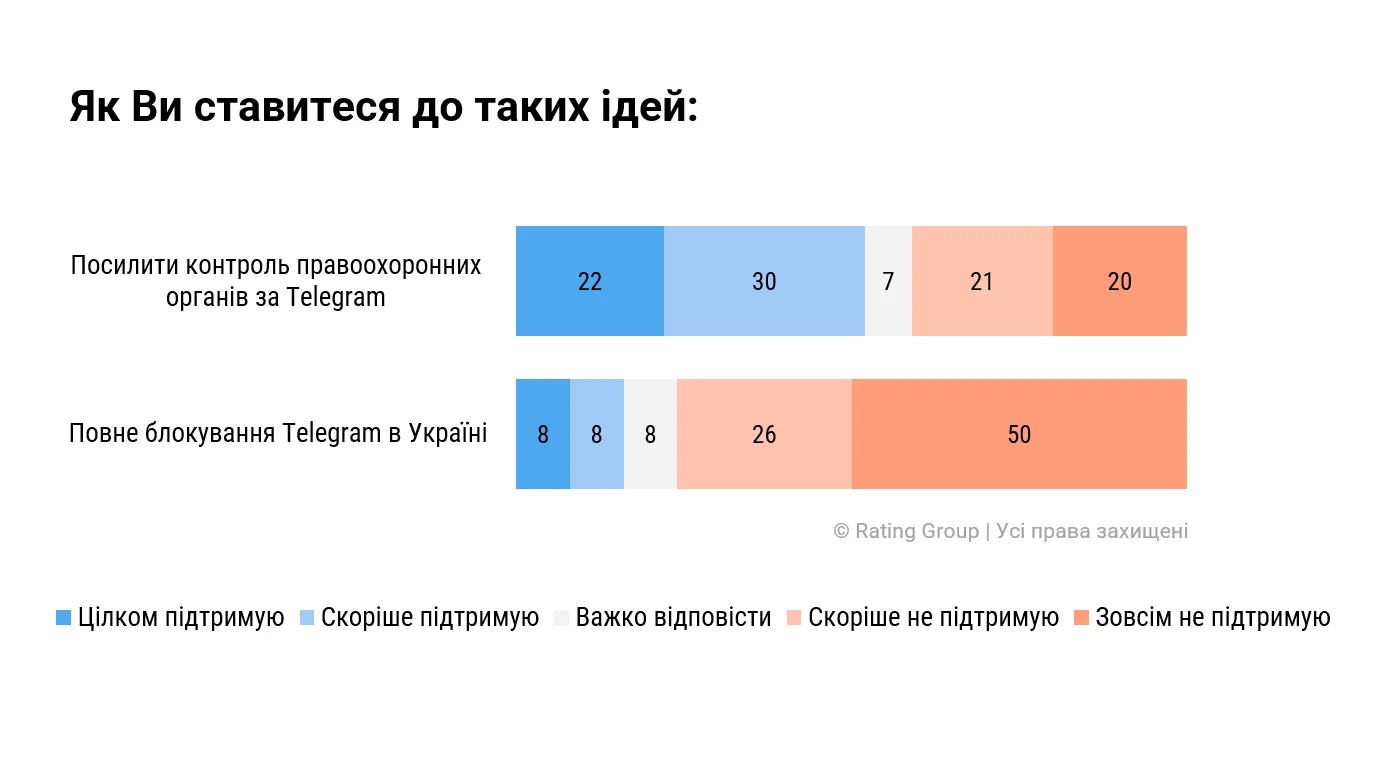
- 76% респондентів виступають проти повного блокування Telegram в Україні. Натомість підтримують таку ідею 16%.
- З іншого боку, більшість опитаних підтримують посилення контролю правоохоронних органів над месенджером, а 41% проти цього.
Rating Group — одна з найбільших дослідницьких інституцій України, яка на ринку з 2008 року. Компанія зареєстрована в Україні та має значний досвід проведення соціологічних опитувань в Україні та за кордоном. До групи входять: Соціологічна група Рейтинг, дослідницька лабораторія Rating Lab, платформа Rating Online та Rating Call Center.

Українці здебільшого вважають переїзд громадян за кордон проблемою для країни, а от до приїзду іноземців ставляться відносно позитивно
У випуску №3 дослідження End of Year Survey розповідаємо більше про те, як українці ставляться до міграції, і порівнюємо це з суспільними поглядами в інших країнах Європи.
End of Year Survey (EoY) - це глобальне щорічне опитування міжнародної соціологічної асоціації Gallup International про майбутнє, щастя й очікування населення різних країн. У 2025 році опитано 64,097 респондентів у 61 країні світу. В Україні опитування EoY вже третій рік поспіль проводить Соціологічна група "Рейтинг" (Rating Group).
Ставлення до виїзду з країни
.webp)
- Абсолютна більшість українців (63%) вважають, що переїзд громадян за кордон шкодить Україні, тоді як лише 11% бачать у цьому користь.
- Відносно менш критично налаштовані молодші респонденти віком 18-35.
- Загалом Україна входить до топ-10 країн Європи з найбільш негативним сприйняттям еміграції.
Ставлення до приїзду людей з інших країн
.webp)
Українці помірно позитивно ставляться до приїзду людей з інших країн
- Найчастіше (37%) респонденти вважають, що це приносить Україні користь, тоді як 27% говорять про шкоду. Також значна частина (28%) займає нейтральну позицію.
- Більш позитивне ставлення мають молодші респонденти, молоді жінки - ще частіше (59%), ніж молоді чоловіки (41%). Серед регіонів найбільш позитивним ставленням вирізняється Київ - там 50% говорять про користь від імміграції до України.
- Ставлення українців до імміграції є співставним або навіть дещо позитивнішим, ніж у багатьох інших країнах Європи.
Rating Group — одна з найбільших дослідницьких інституцій України, яка на ринку з 2008 року. Компанія зареєстрована в Україні та має значний досвід проведення соціологічних опитувань в Україні та за кордоном. До групи входять: Соціологічна група Рейтинг, дослідницька лабораторія Rating Lab, платформа Rating Online та Rating Call Center.

In early February 2025, Rating Group studied how Ukrainians perceive parcel delivery and international mail services, how they use them, and what they think about a potential increase in taxes on international parcels.
Key findings
- An absolute majority of respondents (82%) do not support the introduction of a 20% VAT on all international parcels.
- About half of Ukrainians actively use parcel delivery services within Ukraine, while one third received international parcels over the past year.
- Two thirds of Ukrainians emphasize the importance of international parcels during wartime.
Use of parcel delivery services
- Nearly one third of Ukrainians (29%) received international parcels over the past year. In most cases (68%), the parcel value was up to €50, which is the most common category among both higher-income and lower-income groups.
- At the same time, about half of Ukrainians actively use domestic parcel delivery services, meaning they send or receive parcels at least once every few months. More than one third of them do so several times per month.
- Among those who received goods from abroad, nearly one third (29%) ordered items that were important for overcoming the consequences of the energy crisis.
- Overall, the most popular items received through international mail are clothing and footwear (45%), as well as power banks, batteries, and charging devices (26%).
Assessment of the importance of international parcels
- Most Ukrainians recognize the importance of international postal parcels during the war (64%), including one quarter who consider them critically important.
- An absolute majority believe that increased costs of international parcels could negatively affect volunteer activities and defense efforts (79%).
- Even more Ukrainians believe that delays in international parcels could negatively affect these areas (85%).
Rating Group is one of the largest research institutions in Ukraine, operating since 2008. The company is registered in Ukraine and has extensive experience conducting sociological research both domestically and internationally. The group includes the Rating Sociological Group, Rating Lab research laboratory, the Rating Online platform, and the Rating Call Center.

How does Ukrainian society perceive Pope Leo XIV? We present the findings in Issue No. 2.2 of the End of Year Survey.
The End of Year Survey (EoY) is a global annual study conducted by the international research association Gallup International, exploring people’s views on the future, happiness, and expectations across countries. In 2025, 64,097 respondents were surveyed in 61 countries worldwide. In Ukraine, the EoY survey has been conducted for the third consecutive year by the Sociological Group “Rating” (Rating Group).
Key Findings
- 56% of respondents in Ukraine express a positive attitude toward the Pope. This is higher than the average across 58 countries worldwide (49%).
- In particular, 11% of respondents in Ukraine view Leo XIV very positively, while 45% view him rather positively. At the same time, 22% hold a negative attitude, and 23% remain undecided. Overall, this indicates a moderately positive perception.
- The warmest attitudes toward Pope Leo XIV are observed in the western regions of Ukraine (67% express a favorable view).
- Globally, the most positive attitudes toward the Pope are recorded in Kenya, Croatia, Azerbaijan, Peru, Ecuador, Hungary, the Slovak Republic, Portugal, Ireland, and Poland.
Rating Group is one of the largest research institutions in Ukraine, operating since 2008. The company is registered in Ukraine and has extensive experience conducting sociological research both domestically and internationally. The group includes: Sociological Group Rating, the research laboratory Rating Lab, the Rating Online platform, and the Rating Call Center.

In Issue No. 2.1 of the End of Year Survey, we analyze what Ukrainians said about their attitudes toward the leaders of the United States, China, and Russia at the end of 2025.
The End of Year Survey (EoY) is a global annual survey by the international sociological association Gallup International that explores the future, happiness, and expectations of people in different countries. In 2025, 64,097 respondents were surveyed in 61 countries worldwide. In Ukraine, the EoY survey has been conducted for the third consecutive year by the Rating Group.
President of the United States Donald Trump
- Ukrainians’ attitudes toward U.S. President Donald Trump are moderately negative.
- Most often (47%), respondents report a rather negative attitude toward the U.S. president, while another 25% feel very negative. Overall, 22% express a positive attitude.
- Relatively more favorable views of Trump are found among young men aged 18–35 (35%).
President of the People’s Republic of China Xi Jinping
- Negative attitudes toward President Xi Jinping prevail in Ukraine.
- 80% of Ukrainians view China’s leader negatively (40% very negative, 40% rather negative).
- One in ten respondents has a positive attitude, and another one in ten is undecided.
President of russia vladimir putin
- Ukrainian society holds an extremely negative attitude toward the leader of the russian federation.
- Overall, 99% of respondents in Ukraine express a negative attitude toward the Russian leader.
- Globally, he is also perceived predominantly negatively—on average by about two-thirds of respondents across 58 countries. The most negative views of Putin are recorded in Nordic countries, Estonia, the Republic of Korea (South Korea), the Netherlands, Poland, Japan, and Spain.
- More positive attitudes toward Putin are found among respondents in Serbia, India, Azerbaijan, South Africa, Thailand, Armenia, Kenya, Mexico, Malaysia, and Ecuador.
Rating Group is one of the largest research institutions in Ukraine, operating since 2008. The company is registered in Ukraine and has extensive experience conducting sociological surveys both domestically and internationally. The group includes Sociological Group Rating, Rating Lab research laboratory, the Rating Online platform, and the Rating Call Center.
.webp)
The Rating Group sociological agency has published the first results of the End of Year Survey 2025 as part of the Gallup International global project!
The End of Year Survey (EoY) is a global annual survey conducted by the international sociological association Gallup International on the future, happiness and expectations of the population of different countries. In 2025, 59,636 respondents in 60 countries around the world were surveyed. In Ukraine, the End of Year Survey has been conducted by Rating Group for the third year in a row.
To this end, in November 2025, the team asked 1,000 citizens about their views on the overall situation, expectations for economic development, world peace, pressing issues and trends.
Why is this important?
Conducting EoY means representing Ukraine in prestigious international studies. Gallup International Association was founded in 1947 by George Gallup, one of the fathers of modern scientific public opinion polling, and brings together respected research organisations from around the world.
In turn, End of Year is the Association's flagship annual survey. It is one of the largest internationally coordinated surveys of public opinion in the world.
When will the publications be released?
Traditionally, EoY international data is divided into several thematic blocks and released gradually throughout the year.
The first issue of the EoY series has already been released. Its theme is Ukrainians' general expectations for the coming year.
Rating Group is one of Ukraine's largest research institutions, operating since 2008. The company is registered in Ukraine and has extensive experience in conducting sociological surveys in Ukraine and abroad. The group includes: Sociological Group Rating, Rating Lab research laboratory, Rating Online platform, and Rating Call Centre.

The End of Year Survey (EoY) is a global annual survey conducted by the international sociological association Gallup International on the future, happiness and expectations of the population of different countries. In 2025, 59,636 respondents in 60 countries around the world were surveyed. In Ukraine, the EoY survey has been conducted for the third consecutive year by the Rating Group sociological agency.
This is the first issue in the EoY series. Its theme is Ukrainians' general expectations for the coming year. To this end, in November 2025, we asked 1,000 citizens about their views on the overall situation, their expectations for economic development and world peace.
General expectations for 2026
A relative majority of Ukrainians are generally optimistic about 2026. However, there is a downward trend in positive sentiment and an increase in scepticism about change.
- In 2023, half (51%) of Ukrainians believed that the following year would be better, while now only 39% hold this view. Nevertheless, this is still a relatively common view of the situation.
- The percentage of those who believe that nothing will change is 27% (compared to 20% in 2024). The proportion of ‘pessimists’ has also remained virtually unchanged: as in 2024, one in four respondents now believes that next year will be worse.
- Rural residents and older people aged 51+ are more optimistic about the situation. On the other hand, the most pessimistic are younger men, especially those aged 18-35.
- In general, Western and Eastern Europe are dominated by feelings of stagnation and deterioration. Against this backdrop, Ukrainians tend to be more optimistic.
Economic expectations
As was the case a year ago, Ukrainians are preparing for economic difficulties. This is in line with the general European and global trend of economic pessimism.
- Perceptions of economic prospects have remained virtually unchanged over the past year: about two-thirds of respondents believe that 2026 will be a year of economic hardship, one in ten expects prosperity, and one in five believes that nothing will change. In 2023, the share of economic pessimism was slightly lower (52%), but for the second year in a row, it has remained at 63-64%.
- Residents of the west and villages have slightly more optimistic economic expectations. Once again, young men have a more negative outlook.
- In general, economic pessimism is a global trend, especially in Western and Eastern Europe. Ukraine is among the top five countries with the highest economic pessimism, along with Belgium, France, Latvia, and Germany.
Expectations for world peace
Society's hopes for world peace are growing.
- Scenarios for world peace are divided roughly equally: one-third of Ukrainians believe that the year will be more peaceful, another third believe it will be the same, and the remaining third believe it will be more turbulent.
- However, we see a growing trend of hope for a more peaceful world: while a third of Ukrainians currently hold this view, in November 2023 it was only 26%.
- In the vast majority of countries where the survey was conducted, the prevailing sentiment is that the world will be more turbulent. For example, 55% of respondents in Western Europe and 42% in Eastern Europe believe this to be the case. Thus, Ukrainians have slightly higher expectations for an improvement in the global security situation.
Rating Group is one of Ukraine's largest research institutions, operating since 2008. The company is registered in Ukraine and has extensive experience in conducting sociological surveys in Ukraine and abroad. The group includes: Sociological Group Rating, Rating Lab research laboratory, Rating Online platform, and Rating Call Centre.

The Rating Group and the International Organization for Migration (IOM Ukraine) published the results of a joint study on social services for veterans in Ukraine. The study was conducted with the support of the European Union and in cooperation with the Ministry of Veterans Affairs of Ukraine.
The aim of the study is to identify factors that promote or hinder the social integration of war veterans, as well as to assess their interaction with the social services system, in particular through the Administrative Services Centres, as indicators of the implementation of the Veterans Policy Strategy in Ukraine.
The survey covered war veterans from various demographic groups, including persons with disabilities, as well as employees of the Administrative Service Centres from all regions of Ukraine controlled by the Government. In addition, in-depth interviews were conducted with war veterans, support specialists, representatives of civil society organisations and opinion leaders whose activities are directly related to the formation of veteran policy. The data obtained allows for an analysis of the extent to which the current infrastructure, service delivery mechanisms and state guarantees are in line with the objectives of the Veterans Policy Strategy.
Key findings
The main difficulties in returning war veterans to civilian life are associated with a misunderstanding of society, difficulties with the registration of social benefits, employment and access to medical and psychological support.
- The state of implementation of public policy in the field of veteran benefits and services is generally rated low due to bureaucracy, insufficient funding and poor coordination between authorities.
- Medical services, particularly primary care, receive positive ratings, while psychological support and social services, including family assistance and veteran business development, remain weak.
- War veterans actively use the services of ASCs, noting the professionalism of the staff, but bureaucratic procedures and the complexity of documents complicate access to benefits.
- Housing programs and legal support are limited in resources and complexity of procedures, which requires their simplification and unification.
- Despite this, there are positive dynamics in the availability of medical services, the development of veteran hubs, rehabilitation programs and grant initiatives.
- The main requests of war veterans relate to medical care, psychological support, housing support, legal assistance, and employment and training opportunities.
- It is recommended to simplify the system of benefits, automate processes, increase the competence and empathy of employees, as well as shift the focus from payments to the development of initiatives and self-realization of war veterans.
- In the long term, it is expected to improve the availability and quality of services, the expansion of housing and social programs, and the integration of all services for war veterans in one environment.
- An important factor in the effectiveness of the implementation of the veteran policy is the active participation of war veterans themselves in communities and public initiatives, which contributes to their social integration and capacity development
Authors of the report: Lyubomir Mysiv, Natalia Khalimonenko, Roman Borysov, Anna Konstantinova
Rating Group is one of the largest research institutions in Ukraine, which has been on the market since 2008. The company is registered in Ukraine and has significant experience in conducting sociological surveys in Ukraine and abroad. The group includes: Sociological Group Rating, Research Lab Rating Lab, Rating Online platform and Rating Call Center.

The Rating Group continues to research veteran issues and promote evidence-based public policy in the veteran sphere.
On 23 December 2025, together with the Ukrainian Veterans Fund of the Ministry of Veterans Affairs of Ukraine, we presented the results of a new joint study, ‘Problems of War Veterans in Ukraine’ (part of the ‘Portrait of a Veteran 2025’ project). This is a continuation of our history of effective cooperation with the UVF, which has been ongoing since 2022.
In December, Rating Group researchers surveyed 240 defenders of Ukraine about their needs, support programmes, and challenges. As the company's CEO Oleksii Antypovych said during the presentation, Ukrainian veterans' greatest need is for material and medical support. According to the survey, 50% and 43% of veterans indicated this, respectively.
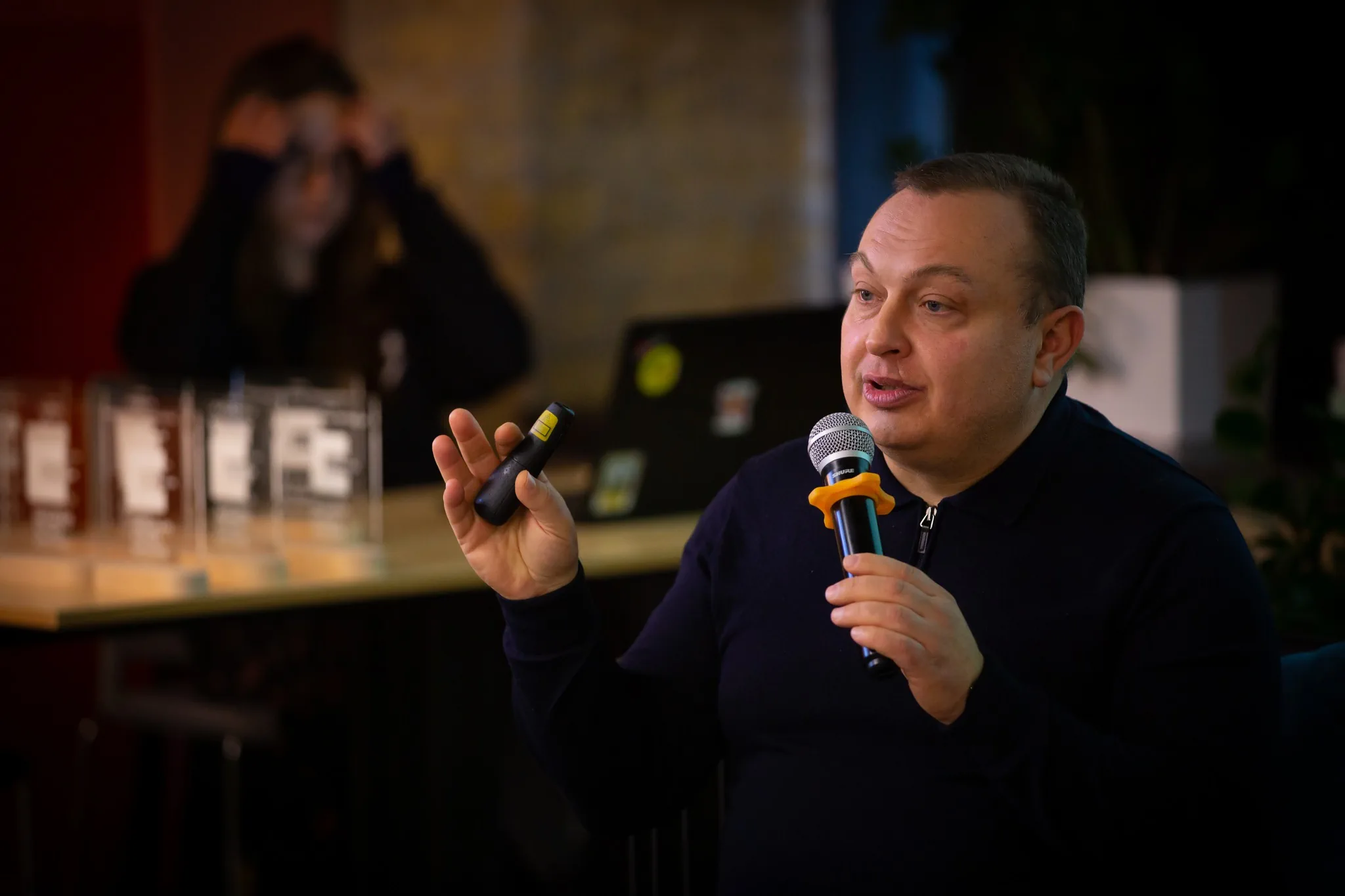
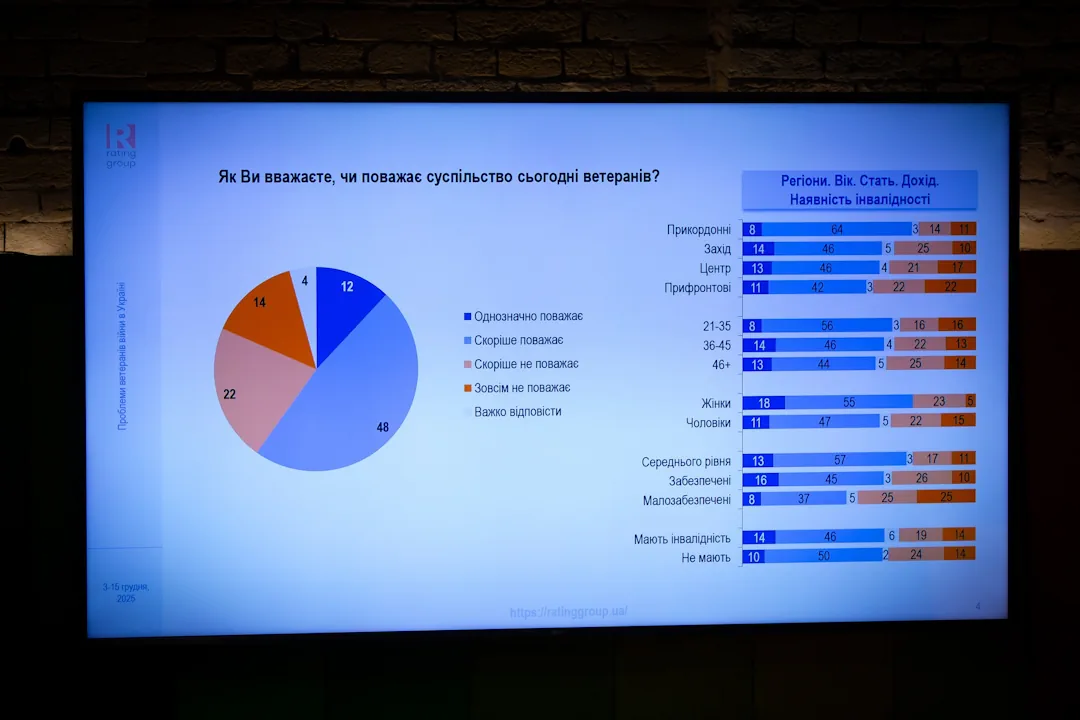
At the same time, a third of veterans feel that society does not give veterans the respect they deserve, and a significant proportion also doubt the effectiveness of state support. Therefore, Oleksii Antypovych emphasises:
"Our defenders are people who risk their lives and health for the sake of everyone, and it is important that society shows its gratitude. Such studies help us understand what kind of support veterans really expect. For example, Ukrainians often think that veterans primarily need free psychological help. And, of course, mental health is extremely important. But our survey shows that veterans also have a huge demand for various forms of material support."
Nataliia Kalmykova, Minister for Veterans Affairs of Ukraine, noted the importance of sociological research in shaping state veterans policy, as it reveals the real needs of veterans.
"In particular, through [...] the Ukrainian Veterans Fund of the Ministry of Veterans Affairs, we are implementing [veterans] policy — supporting veterans' businesses and community initiatives, as well as conducting systematic research. In the future, we will intensify this work by expanding support tools and relying on data and the real needs of veterans," said Nataliia Kalmykova, Minister for Veterans Affairs of Ukraine, about the Rating Group/UVF study.
This was confirmed by Karina Doroshenko, Executive Director of the UVF:
"Our work is based on research. In particular, in 2025, as part of the Varto programme, the Ukrainian Veterans Fund supported 336 projects [...] It is important for us that every figure in our report corresponds to the real needs of veterans," said Karina Doroshenko, Executive Director of the UVF, about the Rating Group/UVF study.
The Rating Group team would like to thank its partners at the Ukrainian Veterans Fund and the Ministry of Veterans Affairs for their cooperation and for the opportunity to help highlight the needs of defenders.
The results of the study are available at the link.
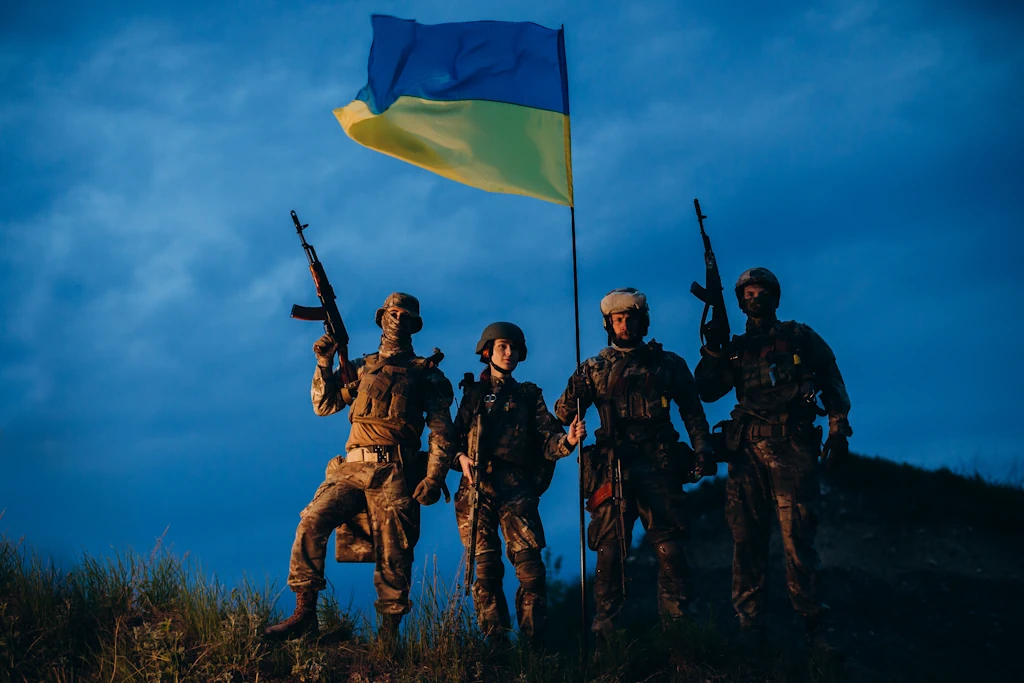
The Rating Group sociological group surveyed 240 defenders of Ukraine as part of a study entitled ‘Problems of War Veterans in Ukraine.’ The survey was conducted on the initiative of the Ukrainian Veterans Fund of the Ministry of Veterans Affairs of Ukraine and is part of the ‘Portrait of a Veteran 2025’ project.
The research team learned about the main challenges veterans face when returning to civilian life, their needs, and their perceptions of the effectiveness of support programmes.
Challenges in civilian life
One-third of Ukrainian veterans feel that society does not respect them today
- At the same time, 60% of the veterans surveyed responded that society does respect veterans. Also, the majority of respondents (58%) believe that society is not informed about the needs and problems of veterans in civilian life.
- Psycho-emotional instability (84%), alcohol or drug abuse (79%), lack of understanding from society (76%), physical health problems and difficulties in obtaining medical care (75%), unemployment (73%), lack of inclusive spaces and adapted workplaces for people with disabilities (72%), and conflicts in the family (71%) are negative phenomena that, according to veterans, are likely to arise in their lives after returning from war.
- Sixty per cent mentioned the incompatibility of military experience with civilian life, 58 per cent mentioned problems with obtaining social benefits, 51 per cent mentioned the risk of breaking the law and participating in crime, and 48 per cent mentioned suicide.
Meeting the needs of veterans
We asked veterans to rate how well their various needs were being met on a 5-point scale (1 – not met at all, 5 – completely met). Respondents could also indicate that they did not have such needs at all.
- The best-rated need was discounted travel (4.3 points on average).
- Average ratings were given to medical care (3.3), physical rehabilitation and/or prosthetics (3.3), employment (3.2), psychological support (3.1), educational needs/retraining (3.1 points), information and counselling support (3.1), business development (3.0) and financial support for families (3.0).
- The respondents rated legal support (2.7) and housing provision (2.6) the lowest.
What kind of support do veterans need?
Financial (50%) and medical (43%) support are the main requests of veterans.
- About a quarter of respondents indicated psychological support (28%) and housing assistance (26%), while one in five (22%) indicated legal support.
- Only one in ten said they did not need any support today.
Use of benefits and support programmes
- Most often, veterans use subsidies for utility payments (69%), free travel (52%), medical care (41%), and pensions (33%).
- Financial assistance was mentioned by 21%, psychological rehabilitation by 14%, education benefits by 12%, and educational services and benefits by 10%.
- Only 8% of respondents said they did not use any of the benefits or programmes mentioned.
Effectiveness of veteran support programmes
- Opinions on the overall effectiveness of state veteran programmes were divided: 51% believe that they are effective, while 40% of respondents question their effectiveness.
- State rehabilitation and prosthetics programmes for persons with disabilities are considered effective by 59% of respondents, 27% of respondents have the opposite opinion, and 15% were unable to assess them.
- Assessments of the accessibility (inclusiveness) of public spaces for persons with disabilities were also divided: 47% believe that they are completely or somewhat accessible, 47% of respondents question their accessibility, and another 7% were unable to assess them.
- On the other hand, the effectiveness of programmes run by non-governmental organisations (civil society organisations, charitable foundations, volunteer associations) to support veterans is rated much higher by respondents. 75% of respondents consider them to be completely or somewhat effective, while 17% hold the opposite opinion.
Rating Group is one of Ukraine's largest research institutions, operating since 2008. The company is registered in Ukraine and has extensive experience in conducting sociological surveys in Ukraine and abroad. The group includes: Sociological Group Rating, Rating Lab research laboratory, Rating Online platform, and Rating Call Centre.