
18.03.2026
What kind of self-realization does Ukrainian youth seek at home and in the EU? Results of a study by Rating Group, UNDP Ukraine, and the Ministry of Youth and Sports

What kind of self-realization do young Ukrainians seek? In which fields do they want to work, and how do they set their priorities?
In autumn 2025, Rating Group (Sociological Group “Rating”) surveyed more than 2,000 Ukrainians aged 14–35 in Ukraine, as well as 600 representatives of Ukrainian youth in European Union countries. Below we present the key findings of the quantitative phase in the context of professional self-realization.
These findings are part of a large-scale mixed-method study, “The Impact of War on Youth in Ukraine 2025,” conducted by Rating Group at the initiative of the Ministry of Youth and Sports of Ukraine, with the support of the United Nations Development Programme (UNDP) in Ukraine and the Government of Denmark. The research project highlights how Ukrainian youth feel and how they are changing during the full-scale war.
Priorities of young people over the next 5 years
Financial independence and self-realization are the key personal goals of young Ukrainians for the next five years.
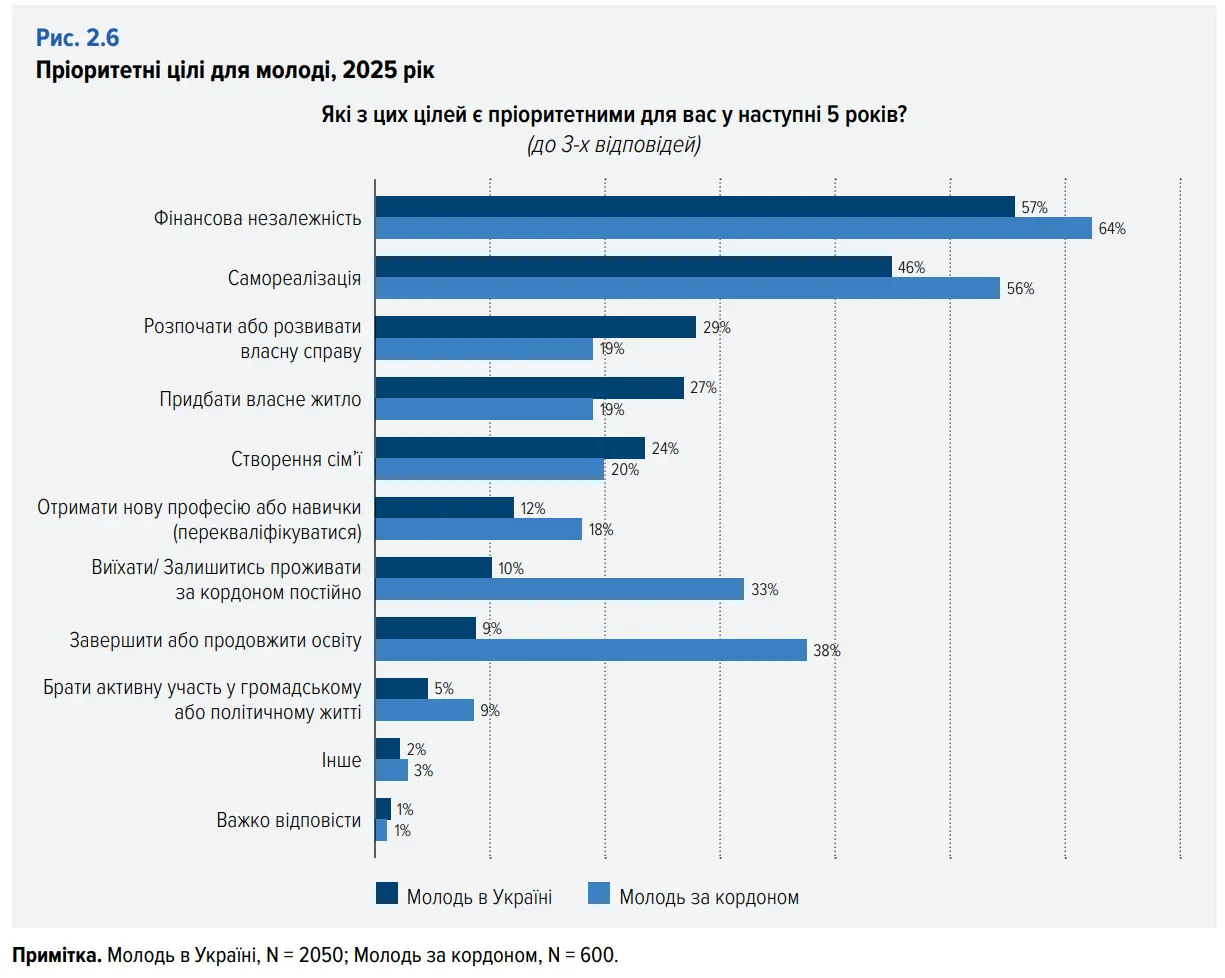
- The main personal priorities are financial independence (57% in Ukraine and 64% abroad) and self-realization (46% and 56%, respectively). In Ukraine, financial independence is more often emphasized by respondents aged 14–19.
- Young people in Ukraine are more likely to aspire to start their own business (29% compared to 19% among Ukrainian youth in the EU) and to purchase housing (27% compared to 19%).
- It is also expected that respondents aged 20–24 (37%) and 25–29 (30%) are more likely to plan starting a family within the next five years.
- Ukrainian youth abroad often mention the goal of settling abroad (33%), which aligns with plans to complete or continue their education (28%).
Where do they want to work?
Own business, IT, creative professions, and law are the most popular career paths among Ukrainian youth.
- Two-thirds of surveyed young people in Ukraine want to work in the private sector.
- Meanwhile, one in five respondents mentions the public sector, and 8% the civic sector.
- When asked to choose three most desirable professions, young people in Ukraine most often named entrepreneur (30%). Other popular choices include software specialist (17%), designer (18%), lawyer (15%), creative professions (14%), and manager in a commercial company (13%). Military service as a profession attracts 12% of respondents.
- Youth abroad are noticeably more likely to choose the following professions: entrepreneur (38%), software and computer technology specialist (28%), and creative professions (27%). At the same time, a quarter of respondents abroad (27%) selected the option “other profession” (compared to 7% in Ukraine).
Skills young people want to develop
Young people in Ukraine tend to focus more on digital literacy, while Ukrainian youth in the EU place greater emphasis on soft skills, resilience, and entrepreneurial abilities.
We asked respondents to select up to five skills they would like to develop in order to achieve their future plans.
- Among youth in Ukraine, the highest demand is for developing stress resilience and computer literacy (each selected by more than one-third of respondents). Around a quarter also highlighted the importance of creativity, entrepreneurial skills, and critical thinking.
- Youth abroad generally selected more options in this question. They place relatively greater emphasis on stress resilience (44% vs. 36% in Ukraine), entrepreneurial skills (37% vs. 23%), productivity (33% vs. 11%), as well as communication skills, adaptability, leadership, and social inclusion.
- Overall, youth abroad are more oriented toward soft skills related to adaptation and social interaction, while youth in Ukraine are relatively more focused on digital competencies (35% vs. 25% abroad).
Rating Group is one of the largest research institutions in Ukraine, operating since 2008. The company is registered in Ukraine and has extensive experience in conducting sociological research both domestically and internationally. The group includes the Sociological Group “Rating,” the research laboratory Rating Lab, the Rating Online platform, and the Rating Call Center.
Methodology
Methodology of the quantitative phase in Ukraine
- Fieldwork period: September 10–21, 2025
- Survey method: CAPI (Computer-Assisted Personal Interviewing) – face-to-face interviews using tablets
- Sample size: 2,050 respondents (youth aged 14–35 in Ukraine)
- Sampling design: random, stratified, multi-stage sample representative of youth aged 14–35 in government-controlled territories
- Representativeness: the sample is representative by age, gender, type of settlement, and region; margin of error does not exceed 2.2% at a 95% confidence level
Methodology of the quantitative phase abroad
- Fieldwork period: September 11–17, 2025
- Survey method: CAWI (Computer-Assisted Web Interviewing) – online survey conducted via the Rating Online platform
- Sample size: 600 respondents
- Sampling design: targeted sample of Ukrainian youth who left after February 24, 2022 and currently reside in EU countries
- Representativeness: margin of error does not exceed 4% at a 95% confidence level
Contact form
Let's discuss your research idea
Fill in the form below, and we will contact you as soon as possible


