
06.03.2026
Gender, roles, stereotypes. How have the views of Ukrainians changed in 10 years (2015-2026)?

Do Ukrainians notice inequality between men and women? Which gender stereotypes are still widespread, and which have already faded? Are Ukrainians today supporters of a traditional division of gender roles within the family or a couple?
Ultimately, how has Ukrainian society changed in this regard over the past decade?
To explore these questions, at the end of February 2026 Rating Group and the research laboratory Rating Lab surveyed Ukrainians on issues of gender (in)equality, stereotypes, and perceptions of relationships within families and couples. The results are presented in a dynamic perspective, comparing the findings with similar studies conducted in 2015 and 2021.
"Our longitudinal research indicates a gradual transformation of gender perceptions in Ukraine: gender equality is perceived more strongly, traditional stereotypes are weakening, and partnership-based models are becoming more acceptable, especially among young people, who tend to be more progressive and egalitarian,” summarizes Marianna Tkalych, CEO of Rating Lab, Professor, Doctor of Psychological Sciences.
Perception of inequality
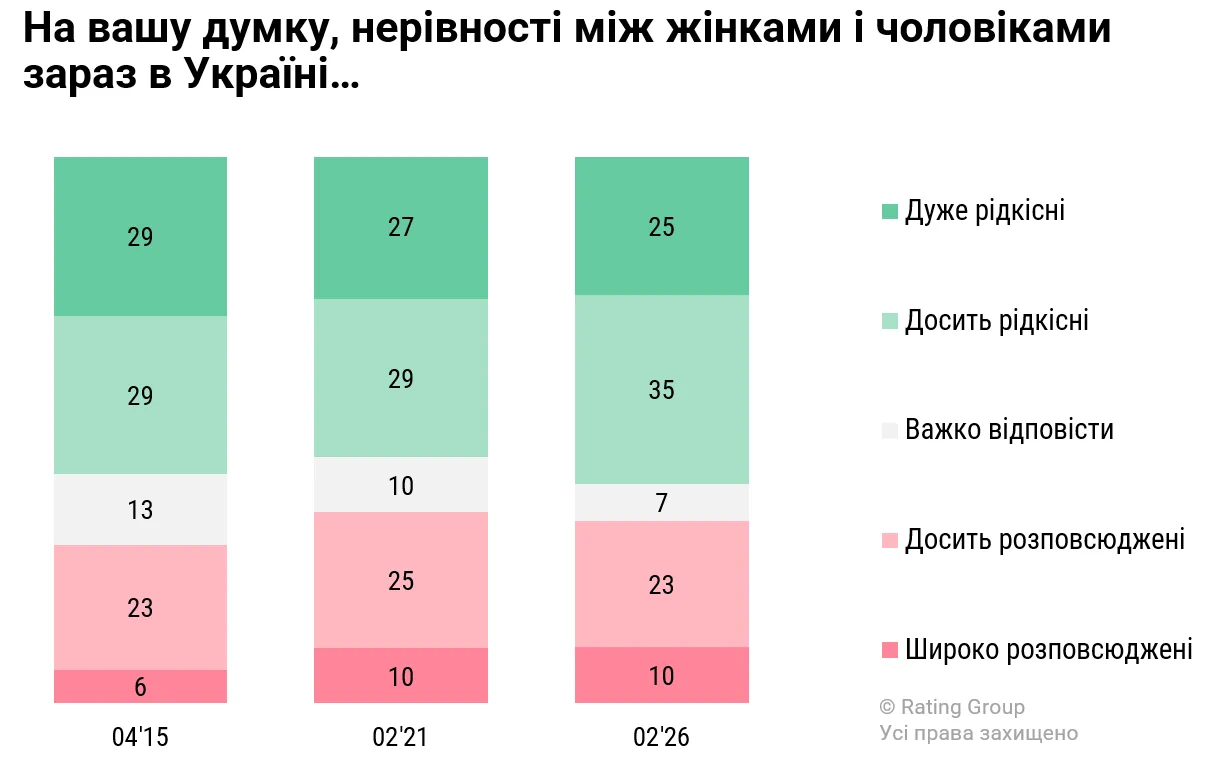
Most Ukrainians consider gender inequality to be a relatively rare phenomenon in the country, and this perception has not changed significantly over the past decade.
- 60% of respondents say inequality between men and women is generally rare in Ukraine. About one third hold the opposite view, while 7% find it difficult to answer.
- Over the last ten years, there have been no major shifts in overall perceptions of this issue.
- However, pessimism has increased among young men aged 18–35: in 2021, 30% of them believed inequality was widespread, whereas today 41% do.
- At the same time, young women aged 18–35 have become somewhat more optimistic: in 2021, 42% in this group believed inequality was widespread, whereas today this share has declined to about one third.
Gender stereotypes
Prejudice regarding men and women is gradually declining in Ukrainian society, with young people increasingly rejecting traditional stereotypes.
Respondents were asked whether they agree or disagree with several gender stereotypes that were previously widespread.
The majority reject almost all of them. The only exception is the belief that a man should fully provide for his family, supported by 69% of respondents.
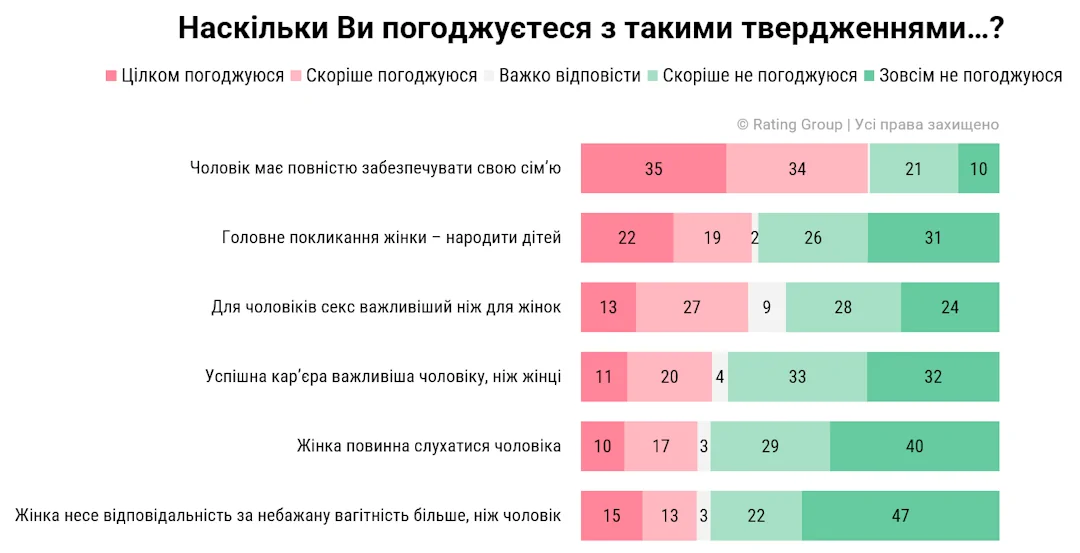
At the same time, all of these stereotypes have become less widespread over the past five years. The most notable declines are in the ideas that a successful career is more important for men and that a woman should obey her husband.
“A man should fully provide for his family”
- This is the only stereotype supported by a majority across all gender and age groups.
- Relatively fewer young women (60%) agree with this statement compared to older women (66%) and men overall (72–74%).
- Support for this idea has gradually decreased over time: the average index on a scale from 1 (“strongly disagree”) to 4 (“strongly agree”) declined from 3.3 in 2015 to 2.9 in 2026.
“A woman’s main calling is to have children", “A successful career is more important for a man than for a woman”
- Most Ukrainians reject these stereotypes. 57% oppose the first statement, while 65% oppose the second.
- Young people stand out particularly strongly in this regard. For example, 75% of young men and 85% of young women aged 18–35 reject the idea that motherhood is a woman’s primary calling.
- By contrast, among respondents aged 51+, the majority still support this idea (54% of women and 59% of men).
“Sex is more important for men than for women”
- Opinions are more evenly divided on this issue. A slight majority (52%) do not support the statement, while 40% agree with it, and 9% are undecided.
- Again, younger respondents are more likely to reject this stereotype: two thirds of men aged 18–35 and 60% of women in the same age group disagree with it.
“A woman should obey her husband", “Women bear more responsibility for unwanted pregnancy than men”
- These stereotypes are rejected by 69% of respondents.
- The shift over time is also significant. The index for the statement “a woman should obey her husband” decreased from 2.8 in 2015 to 2.0 in 2026.
- Similarly, the index for the statement “women bear more responsibility for unwanted pregnancy than men” fell from 2.4 in 2015 to 2.0 today.
Roles in the family and in relationships
В In Ukrainian families and couples, elements of the traditional division of roles still remain. Women are more often responsible for cooking (60%) and household chores (48%), while men are more often seen as earning the main income (68%).
These questions were asked of respondents who currently have or previously had a partner.
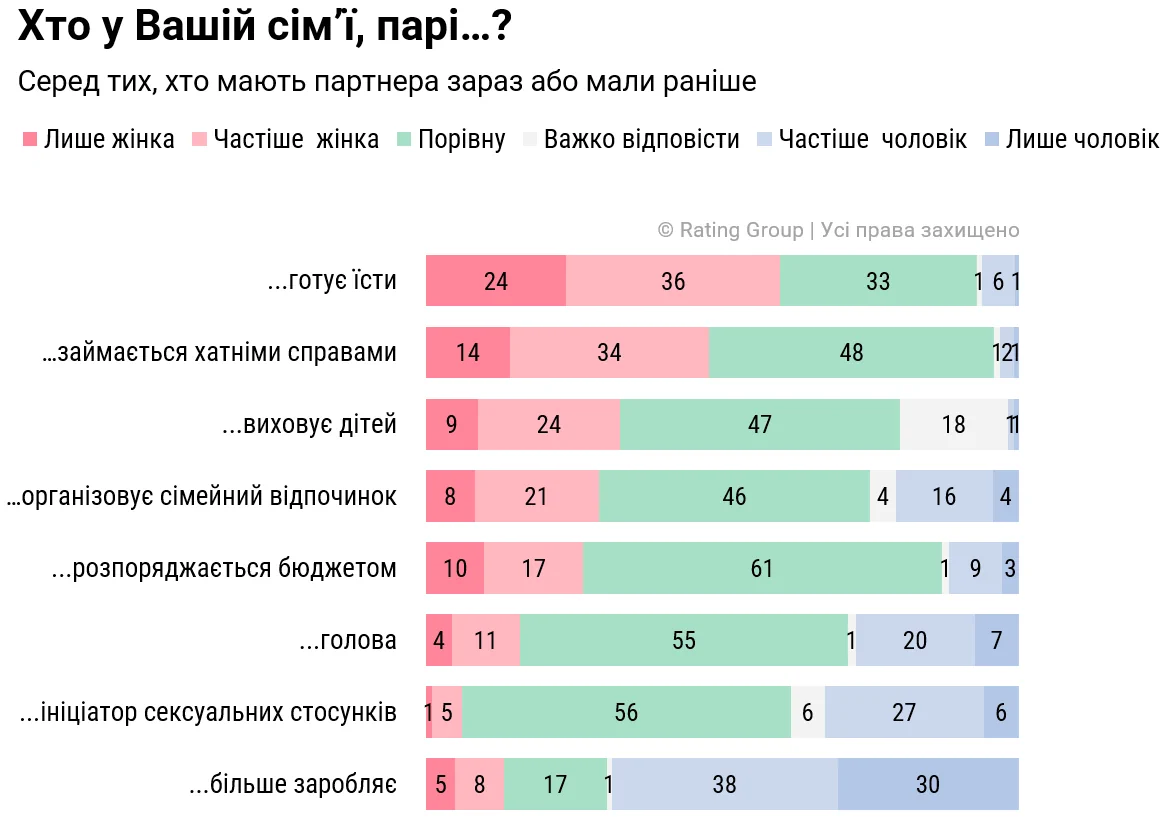
- The responsibilities most often shared equally are managing the family budget (61%), initiating sexual relations (56%), leading the family (55%), child-rearing responsibilities (48%), and organizing leisure activities (46%).
- At the same time, when comparing who is perceived as more responsible — the man or the woman — respondents tend to attribute cooking, household chores, child-rearing, organizing family leisure, and managing the family budget relatively more to women. Men, in turn, are more often associated not only with earning income, but also with family leadership and initiating sexual relations.
- In the dynamic perspective, we observe that cooking, child-rearing, and family leadership are roles gradually shifting toward a partnership-based format, meaning they are increasingly shared equally. However, the role of earning income continues to be delegated primarily to men.
- Young people are significantly less inclined to support traditional models and instead prefer a more egalitarian (equal) distribution of roles. The main exception again concerns income: 80% of men aged 18–35 believe this responsibility should lie with men, and 74% of women in the same age group share this view.
Rating Group is one of the largest research institutions in Ukraine and has been operating on the market since 2008. The company is registered in Ukraine and has extensive experience conducting sociological surveys both in Ukraine and abroad. The group includes Sociological Group Rating, the Rating Lab research laboratory, the Rating Online platform, and the Rating Call Center.
Methodology
- Fieldwork dates: February 26–28, 2026
- Survey method: CATI (Computer-Assisted Telephone Interviewing) – telephone interviews conducted using computer-assisted technology.
- Sample size: 1,000 respondents
- Sampling format: Random sample of mobile phone numbers (population of Ukraine aged 18 and older across all regions, except for the temporarily occupied territories of Crimea and Donbas, as well as areas where Ukrainian mobile service was unavailable at the time of the survey).
- The results were weighted using the latest data from the State Statistics Service of Ukraine.
- Representativeness: The sample is representative by age, gender, and type of settlement. The margin of error does not exceed 3.1% at a 95% confidence level.
Note: In some charts, percentage totals may not add up to exactly 100% due to rounding (including decimal values).
Contact form
Let's discuss your research idea
Fill in the form below, and we will contact you as soon as possible


